Quick Answer
Yes — you can trade in a car you still owe money on, and the loan does not have to be paid off first. The dealership requests a payoff figure from your lender and settles the balance as part of the deal. What decides the outcome is your equity: the trade-in value minus that payoff. Worth more than you owe, and the difference goes toward your next vehicle. Owe more than it is worth, and the shortfall has to be covered, in cash or, if a lender agrees, financed into the new loan. Coast to Coast Motors lists trade-ins among the services at its Texas and Oklahoma locations.
Can you trade in a car you still owe money on?
Yes, and it is one of the more ordinary transactions on any dealership lot. An unpaid loan does not block a trade. It changes who gets paid at the end of it, and in what order.
Here is the part that catches people out: you almost certainly do not have the title, and you do not need it. Oklahoma has been a title-holding state since July 1, 2022, so the lienholder keeps the title until the loan is satisfied, and since July 2025 those titles are issued electronically. Texas records most liens electronically too. The dealership clears the lien with your lender directly, which is why the usual advice to bring your title does not apply to a financed car.
What you cannot do is hand over the keys and walk away from the balance. A trade-in pays the debt; it is not an exit from it.
How trading in a financed car works
Three numbers run the transaction, and only two of them are about the car.
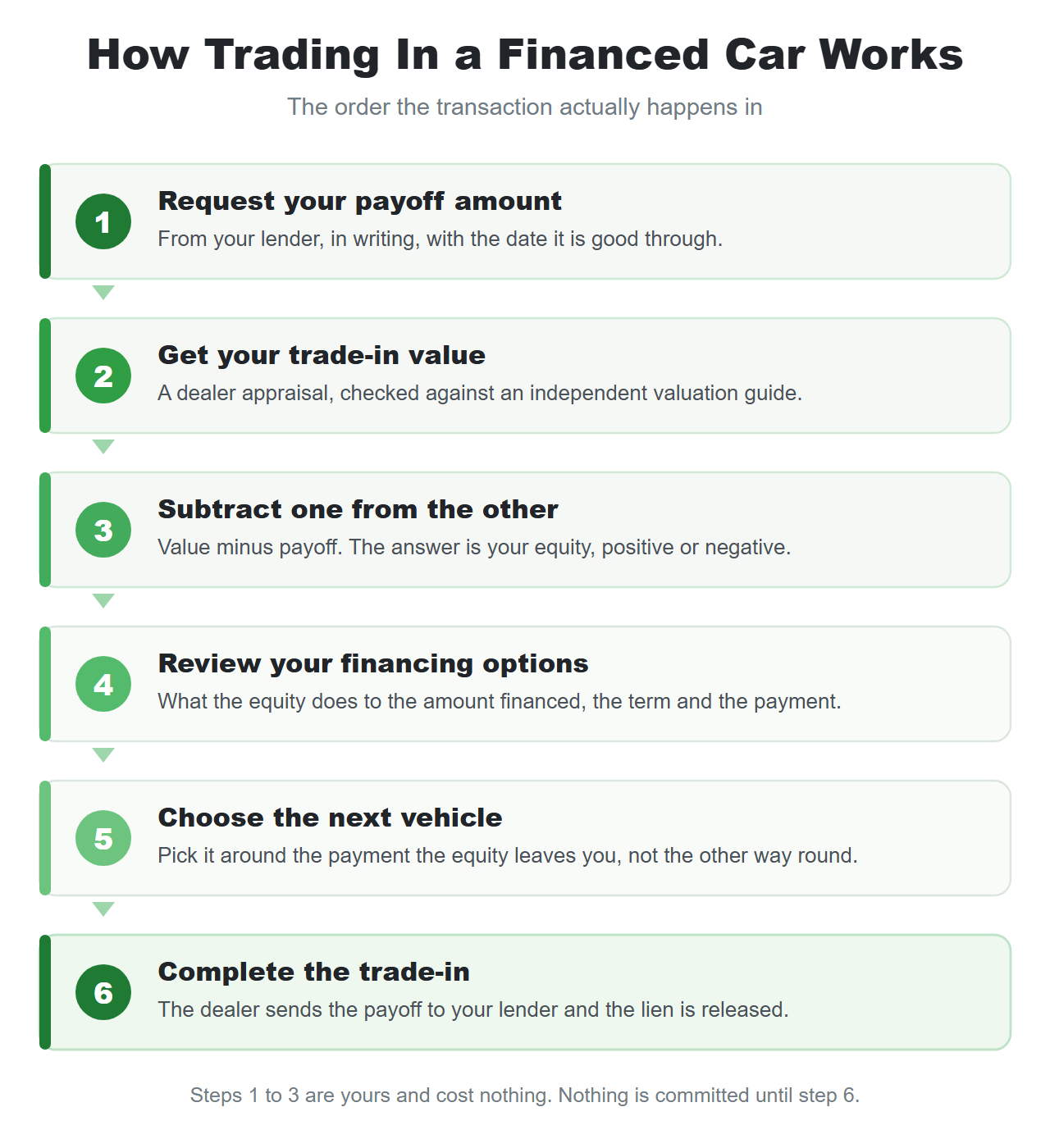
The trade-in value is what a dealer will allow you for the vehicle. The payoff amount is what your lender needs to close the loan that day. The equity is what is left when you take one from the other.
Both of those are easy to confuse with numbers you already have. Your payoff is not the balance on your last statement: the CFPB defines it as the sum needed to satisfy the loan including interest through the day you pay, plus unpaid fees, which is why lenders quote a 10-day payoff good through a specific date. And your trade-in value is not the online listing price for the same model, which carries the reconditioning and margin a dealer puts behind it.
The ending is simpler than people expect. You never pay your lender and you never handle a title: the dealership sends the payoff, the lien comes off, the vehicle changes hands. In Texas a lienholder then has 10 days from receiving payment to release the lien.
Positive equity vs. negative equity
Positive equity means your car is worth more than you still owe on it. Negative equity, also called being upside down or underwater, means you owe more than it is worth. Nothing else separates them, and the trade turns on which one you have.
Being underwater feels like a personal failure and is mostly arithmetic: a vehicle loses value fastest early on while a loan comes down in a straight line. It is also less common than it sounds. Across almost 34 million loans originated from 2018 to 2022, the CFPB found that 11.6% carried negative equity from a trade-in against 32.1% with a positive-equity trade-in. Roughly three in four trade-ins were worth more than what was owed.
| Situation | Vehicle value | Loan payoff | Equity | What it means |
|---|---|---|---|---|
| Comfortably positive | $12,000 | $8,500 | +$3,500 | The loan clears and $3,500 goes toward the new deal. |
| Roughly level | $10,000 | $9,800 | +$200 | The trade covers the loan and little else. Plan on a separate down payment. |
| Slightly underwater | $10,000 | $11,200 | −$1,200 | A $1,200 shortfall to settle in cash or, if a lender agrees, to finance. |
| Well underwater | $9,000 | $14,000 | −$5,000 | A larger shortfall may make paying down the existing loan before trading one option worth considering. |
What happens if your car is worth more than you owe?
The dealer pays off your loan and whatever is left over becomes a credit against the vehicle you are buying. Experian describes the same sequence: the existing loan is settled, and the remainder applied to the new purchase.
That credit behaves like cash you brought with you: it lowers the amount financed, and lenders count it toward the down payment rather than as a discount on the sticker. In Texas there is a tax effect too. The Texas Comptroller lets the value of a traded-in vehicle be deducted from the selling price before motor vehicle tax is computed, provided the trade is part of the same sales transaction.
Two things before you spend it. Equity is not use-it-or-lose-it; if the deal in front of you is wrong, it is still there next month, minus depreciation. And a private sale will often beat a trade-in allowance. What the trade-in buys instead is the loan being settled by someone else, in one transaction, the same day.
What happens if you owe more than your car is worth?
The gap does not disappear, and it does not stop you buying another vehicle. It has to be paid by somebody, and the question is when and by which route.
The FTC puts it plainly: if your car is worth $15,000 and you still owe $18,000, you have $3,000 in negative equity, and to trade the car in you have to pay that $3,000. Three routes exist. Pay it from savings. Ask whether it can be financed into the new loan, turning a lump sum into a larger monthly payment. Or keep the car and pay the loan down until the gap closes, which is cheapest while the vehicle is still reliable.
The same page carries a warning worth repeating. A dealer advertising that it will pay off your loan “no matter how much you owe” may simply be adding the shortfall to your new loan or taking it from your down payment. Saying they are paying it themselves and then rolling it into your financing is illegal, and the FTC asks to be told about it.
How to find out how much equity you have
Two figures and one subtraction. Both figures are free, and you can have them the same afternoon.
Start with the payoff. Log into your lender’s portal or call and ask for a 10-day payoff letter; Experian notes many lenders publish it online and the rest will give it over the phone. Write down the date it is good through.
Then get a value, twice. The FTC points buyers to the NADA Guides, Edmunds and Kelley Blue Book, which is the right place to start, though those are estimates built from what you tell them. A dealer appraisal is the number that ends up on the paperwork, and having both shows whether they agree. Mileage and condition move it further than anything else.
Then subtract the payoff from the value. A positive answer counts toward your next vehicle; a negative answer is the shortfall you need to cover. Either way you walk in already knowing the number, which is the whole point of doing it at home.
Can negative equity be included in a new car loan?
Sometimes, and it is decided per application rather than by a rule. Whether a lender will finance a shortfall depends on how large it is, what the replacement vehicle is worth, and whether the resulting payment still fits the income on your application.
What is worth understanding is the cost of saying yes, because the CFPB has measured it. Rolling a shortfall in raises the amount financed, and the payment and the term tend to follow. Loans carrying negative equity averaged $32,316 financed against $28,244 for loans with a positive-equity trade-in, with average payments of $626 against $496 and average terms of 73 months against 68. On used vehicles the average amount rolled in was $3,284.
That is not an argument against ever doing it, since transport you can get to work in has a value no average captures. It is an argument for two habits. Check the amount financed, the payment and the term on the installment contract before you sign, and read the down payment line beside them, because the FTC notes a shortfall may sit in either. And take the shortest term you can carry.
Not sure what your numbers will support? A free online pre-approval puts a real payment and down payment figure against your situation, so any shortfall is measured against something concrete.
How to prepare before trading in a financed car
Everything on this list is free, and all of it is easier to do at home than at a desk.
- ✓Get the payoff in writing, and note the date it is good through.
- ✓Check the registration for a second name or a second lien. A co-owner has to sign too.
- ✓Gather the registration, your license, proof of insurance and both sets of keys.
- ✓Find your service records and clean the car out. Condition is part of the appraisal.
- ✓Keep paying your monthly payment until the old loan actually reports as paid off.
- ✓Leave your insurance in place until the vehicle has legally changed hands.
The fifth item is the one that quietly does damage. Experian advises allowing 30 to 60 days for a payoff to be reported, and warns that if it has not reached your lender by your next due date, your credit takes the hit even though the car is gone. Paying as normal costs nothing, since an overpayment is refunded. Call the old lender a few weeks later and confirm the account closed.
Trading in your vehicle at Coast to Coast Motors
Coast to Coast Motors lists trade-ins among the services at its stores and offers in-house financing for vehicle purchases. How a particular trade-in is handled is a question to put to the store directly, and the answer is easier to follow when you arrive with your payoff figure and your valuation already in hand.
The process the dealership publishes is short: a one-page application, verification by its finance department, then the loan amount you qualify for, generally inside an hour. Down payments are not preset per vehicle; the store evaluates your information individually rather than matching it to a windshield figure. A down payment is still required, and positive trade-in equity may be applied toward the purchase. Payment history is reported to TransUnion monthly, good months included.
Bring the payoff letter with the documents the store already asks for: proof of income, proof of residence and a phone bill. From there you can browse the inventory across Houston, Oklahoma City and Tulsa, or read how in-house financing works and how it differs from a bank loan. As the dealership puts it, each person’s situation is a little different, so the loan amount and the down payment come out of your application, not a published rule.
The bottom line: owing money on your current car is not the obstacle it feels like. It is a number, and it is knowable before you go anywhere. Get the payoff in writing, get the car valued, subtract one from the other, and you will know whether you are arriving with a down payment already in hand or with a gap to plan around. Buyers who do that arithmetic first tend to do better than the ones who find out at the desk, because they are picking between options they already understand instead of reacting to a figure somebody else just produced.
Ready to see where you stand? Apply online before you bring the trade-in by, or start with what credit score you need to buy a car.
Frequently Asked Questions
Can I trade in a car I still owe money on?
Yes, and you do not have to clear the loan first. The dealership requests a payoff figure from your lender and settles the balance as part of the sale. Your equity, the trade-in value minus that payoff, decides whether the trade puts money toward your next vehicle or leaves a shortfall.
What happens to my old car loan when I trade in?
It gets paid off, not transferred. The dealer sends the payoff to your lender and the lender releases its lien. Allow a few weeks for the account to close on your credit file, and keep paying until it does, because a due date can fall while the payment is still moving.
How do I know if I have positive or negative equity?
Ask your lender for a written payoff amount, get the vehicle valued, and subtract the payoff from the value. A positive answer counts toward your next purchase; a negative answer means you are underwater by that amount. Both figures cost nothing to obtain.
Do I need the title to trade in a financed car?
Usually not, because you almost certainly do not have it. Oklahoma has been a title-holding state since July 2022, so the lienholder keeps the title until the loan is satisfied, and Texas records most liens electronically. The dealership clears the lien with your lienholder.
Can negative equity be added to a new car loan?
Sometimes. It depends on the lender, the vehicle and whether the resulting payment still fits your application, so nobody can answer before reviewing it. Financing a shortfall means borrowing more against a car worth less, which raises the payment and delays the day you are level.
Does trading in a financed car hurt your credit?
The trade itself does not. Applying for the replacement loan adds a hard inquiry, and scoring models count auto loan inquiries inside a 14 to 45 day window as one. The larger risk is a missed payment on the old loan while the payoff is in transit, which paying as normal avoids.
What should I bring when trading in a financed vehicle?
Your written payoff amount, the registration, a valid driver's license, proof of insurance and both sets of keys. Bring service records too, since condition is part of the appraisal. Coast to Coast Motors also asks applicants for proof of income, proof of residence and a phone bill.
Sources
- Coast to Coast Motors — In-House Financing Program FAQs (in-house financing; the one-page application, finance-department verification and approval amount, generally finished in under an hour; no pre-set down payments per vehicle; monthly payment history reported to TransUnion; proof of income, proof of residence and a phone bill requested at application), Get Approved and company information page (trade-ins listed among the services offered)
- Texas Comptroller of Public Accounts — Motor Vehicle Tax Guide: Trade-Ins (a vehicle taken in trade as part of the same sales transaction and transferred directly to the seller may be deducted from the selling price before motor vehicle tax is computed)
- Federal Trade Commission — Auto Trade-Ins and Negative Equity: When You Owe More than Your Car is Worth (the definition of negative equity, the $15,000 / $18,000 worked example, the warning that a dealer who says they will pay the balance themselves and instead rolls it into the loan is acting illegally, the instruction to read the down payment and amount financed on the installment contract, the NADA / Edmunds / Kelley Blue Book valuation sources, and the advice to take the shortest term you can afford)
- Consumer Financial Protection Bureau — Negative Equity in Auto Lending, June 2024, from the auto finance data pilot covering almost 34 million originations from 2018 to 2022 (11.6% of loans included negative equity against 32.1% with a positive-equity trade-in; mean negative equity of $3,284 on used-vehicle transactions and $5,073 on new; average amount financed of $32,316 against $28,244 for accounts with a positive-equity trade-in; average payment of $626 against $496; and average term of 73 months against 68)
- Consumer Financial Protection Bureau — Auto loans key terms (negative equity defined as owing more on the loan than the vehicle is worth) and What is a payoff amount? (a payoff figure covers interest due through the intended payoff date plus unpaid fees, so it is not the same as the current balance)
- Experian — How to Trade In a Financed Car (the 10-day payoff letter, obtained from the online account or by phone; the payoff amount includes interest accrued since the last payment; with positive equity the dealer pays off the loan and applies the remainder to the new purchase; with negative equity the difference is settled in cash or asked to be rolled into the new loan)
- Experian — When Are Accounts Updated to Show as Paid in Full? (allow 30 to 60 days for a payoff to be reported; confirm the lender received it, because a due date passing before the payoff lands can affect your credit even though the vehicle is gone) and Multiple Inquiries When Shopping for a Car Loan (auto loan inquiries inside a 14 to 45 day window are counted as one)
- Texas Department of Motor Vehicles — Add or Remove a Lien on a Vehicle (a lien is recorded on the paper title or held electronically by the department; after the lien is paid off the lienholder has 10 days from receipt of payment to release it)
- Service Oklahoma — Electronic Titles and the title-holding state announcement (Oklahoma became a title-holding state effective July 1, 2022, so a lienholder holds the title until the lien is satisfied; from July 1, 2025 titles are issued electronically, with paper titles in limited cases)