
Quick Answer
Yes. Most people can buy a car without a co-signer, and no lender is allowed to insist on one if you already qualify by yourself. That last part is federal law: under the Equal Credit Opportunity Act a creditor may not require another person to sign when the applicant meets its own standards of creditworthiness. Being told you need one means something specific, in the CFPB's words: the lender "will not offer you the loan based solely on your own income and credit record." That gap is usually closed with verified income, time at your job and address, and a down payment rather than a second signature. Subprime borrowers took 20.60% of used-vehicle loans in the first quarter of 2026, and dealerships that finance in-house, like Coast to Coast Motors, decide on those same factors. A free online pre-approval tells you whether you need anyone else at all.
Key Takeaways
- Most buyers do not need one. A co-signer fixes a specific shortfall; it is not a step in the process.
- A lender cannot require one if you qualify alone. Regulation B says so, and it binds every lender.
- A co-signer lends credit, not income. Their signature backs the debt, but most lenders never add their earnings to yours.
- Being under 18 is the one real exception. A minor's contract can be voided, so someone of legal age has to sign.
- Documents beat signatures. What you can prove about your income and your address moves an application further than another name on it.
- A cheaper vehicle is the fastest fix. A smaller loan shrinks every worry the lender has at once.
- Only an application gives you the real answer. No calculator weighs the vehicle, your income and your file together the way a lender does.
Do you actually need a co-signer to buy a car?
For most buyers, no. A co-signer is not a stage of the car-buying process. It is a remedy a lender reaches for when an application does not stand up by itself, which makes the request specific rather than final. Something in the file is short, and it is almost always nameable. Name it and you can usually close the gap without involving anyone else.
There is also a protection almost no buyer hears about at the desk. Under the Equal Credit Opportunity Act, a creditor may not require another person's signature if you qualify for the amount and terms you asked for under its own standards. Offering one as a way to improve your rate is a fair conversation. Presenting it as mandatory, when your application already clears the bar, is not.
And "need" is not a fixed quantity. It belongs to the lender, not to you. A bank with a hard score cutoff and a dealership that underwrites on income can read the same application and reach opposite conclusions, which is why one rejection says far less about your chances than most buyers assume.
Not sure whether you would be approved on your own? That is precisely what a pre-approval answers. A free online application checks your situation against real lending criteria in a few minutes, with no obligation and no second signer needed to start.
When lenders actually ask for a co-signer
Requests for a co-signer cluster around a handful of situations, and only one of them is genuinely non-negotiable.
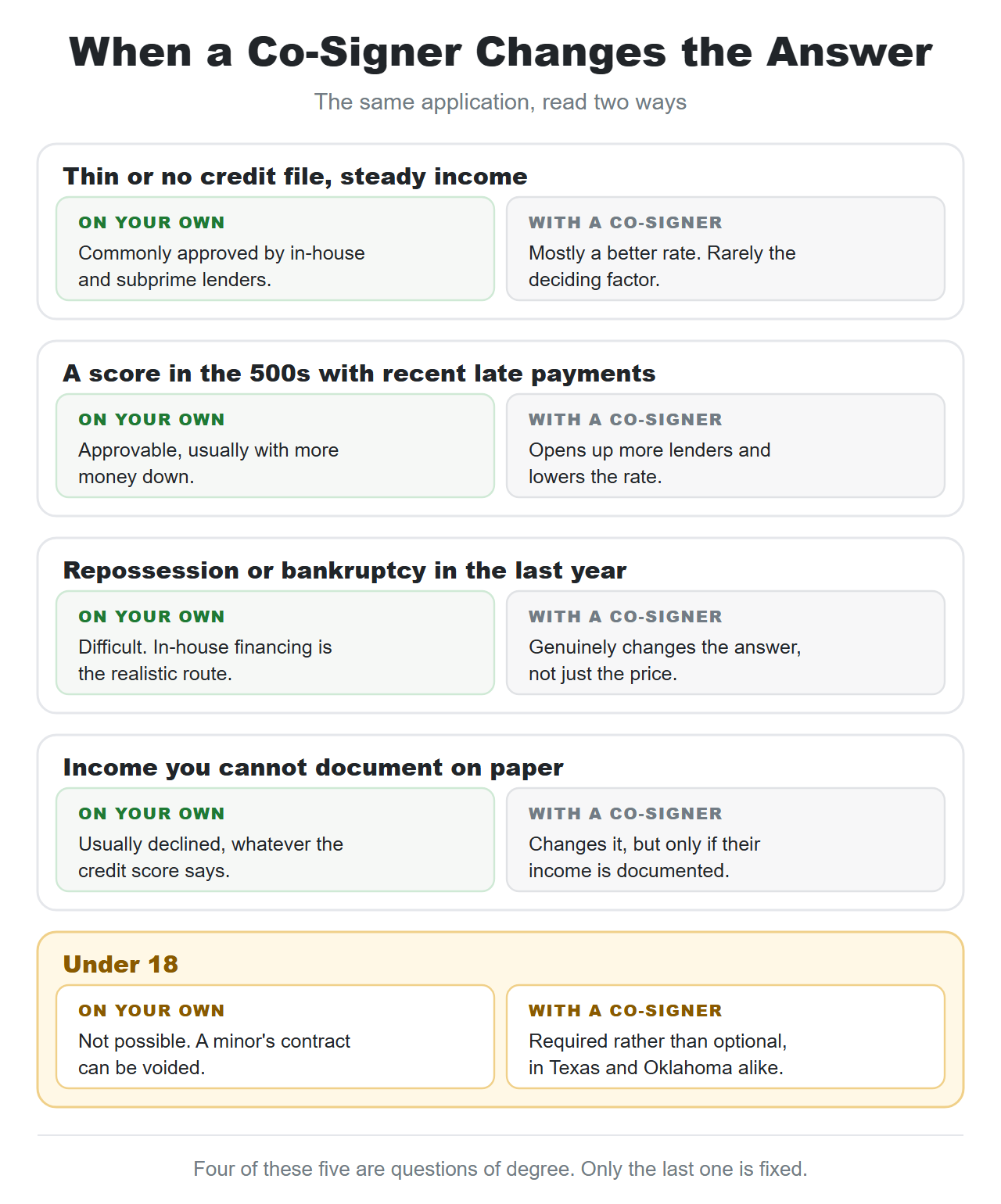
The line the comparison cannot soften is age. Texas and Oklahoma both set the age of majority at 18, and a contract signed by a minor can generally be voided before that birthday, so a dealership financing a 17-year-old holds an agreement it may not be able to enforce. Almost none will. A parent or guardian on that paperwork is not a judgement about credit; it is the only way the contract stands up.
The rest are about the size of the risk rather than the character of the borrower. How the score itself is read across those tiers is covered in our guide to what credit score you need to buy a car.
What a co-signer really is, and what it is not
A co-signer guarantees your loan. They do not buy the car with you, and in most cases their paycheck never enters the calculation. The distinction that trips people up is co-signer versus co-borrower, and it decides what the arrangement can actually fix.
A co-signer promises to pay if you do not. They are not on the title and do not own the vehicle. A co-borrower, sometimes written as co-buyer on the paperwork, applies alongside you: two incomes, two credit profiles and two debt loads assessed together, with both people owning the car.
That difference matters most when your problem is income. A co-signer lends you their credit history, so if the payment is large against what you earn, adding one may not move the decision at all. A co-borrower might, because their income is counted. People regularly ask the wrong relative for the wrong thing and conclude they cannot buy a car.

The obligation also runs heavier than most co-signers expect. Federal rules require the lender to hand them a separate Notice to Cosigner before they sign, and the wording is deliberately blunt: "You may have to pay up to the full amount of the debt if the borrower does not pay... The creditor can collect this debt from you without first trying to collect from the borrower." The CFPB fills in the rest: missed payments land on both credit reports, and if the vehicle is repossessed both parties can be pursued for what the sale does not cover.
What can replace a co-signer?
Everything a co-signer supplies comes down to one thing: reassurance that the payment will be made. Lenders are not attached to the second signature, only to what it reduces, and your own file can supply the same reassurance at no cost to you.
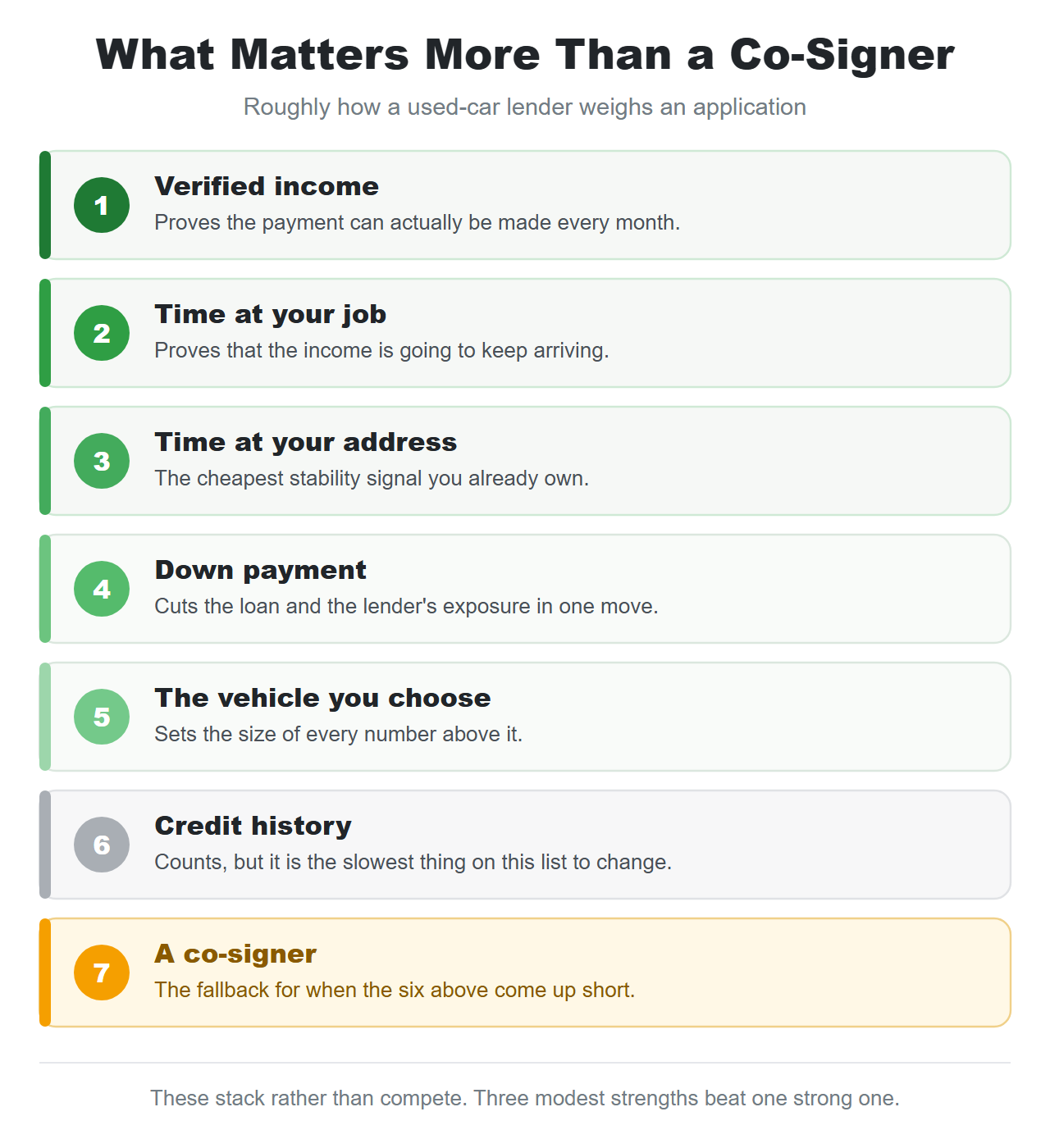
The cheapest item on that list is the one buyers reach for last: the car itself. Those who cannot be approved for the vehicle they walked in for are frequently approved, alone, for one a few thousand dollars cheaper. How much cash to bring is its own question, and our guide to how much down payment you need works through it.
Income, credit score or stability: what carries the most weight
Income sets the ceiling, stability decides whether the lender believes the income, and the credit score mostly sets the price. Three different jobs, which is why a strong score does not rescue a thin income.
The arithmetic behind it is less mysterious than it sounds. Auto lenders generally want your total debt payments at or below 50% of gross income, and subprime underwriting adds a second test on top: payment-to-income, which measures the car payment plus insurance against what you earn and is commonly capped somewhere between 15% and 20%. On $2,600 a month, a 15% ceiling puts the payment and the insurance together at roughly $390. That single figure quietly decides more approvals than any credit score does.
| What the lender checks | What it is really testing | What proves it |
|---|---|---|
| Income | Whether the payment can be made at all | 30 days of pay stubs, bank statements, W-2s or 1099s, or a benefit award letter |
| Employment | Whether that income continues | Time with your current employer; an offer letter if you moved recently |
| Residence | How settled you are, and how easily you can be reached | A lease, mortgage statement or utility bill in your own name |
| Credit history | How you have handled borrowing before | Nothing to bring — the lender pulls it |
An empty credit history is not evidence of anything; a repossession from last spring is. That is why buyers with no file often out-approve buyers with damaged ones. If your file is thin rather than bruised, our guide to buying a car with no credit covers the documents that carry the most weight.
How to strengthen your application without one
Most of what improves a solo application is preparation rather than money. All of it can be finished before you set foot on a lot.
- ✓Put your income and address proof in one folder before you apply, not while you are sitting at the desk.
- ✓Get an insurance quote before you shop. The premium counts against the same income the lender is measuring.
- ✓Decide on a payment, not a car, then look only at vehicles that fit inside it.
- ✓Keep every application inside a two-week window so the credit inquiries are scored as one.
- ✓Apply where the decision is made in-house rather than sent to a bank that never meets you.
The two-week window deserves more than a line, because it is real and free: newer FICO models fold auto-loan inquiries made within 45 days into a single hit, older ones use 14, and VantageScore uses 14, so a fortnight covers you under all of them.
One more thing, which is not on the list because it happens at the desk rather than before it. "Would I be approved on my own, and on what terms?" tells you whether a co-signer is required or merely preferred. And if you have been declined somewhere, a declined applicant is entitled to the specific reasons under that same law. "Declined" is not a reason, and the real one is usually fixable.

So will you be approved on your own?
Nobody can tell you from the outside, and that is not a dodge. The vehicle, the term, your insurance cost and the lender's own appetite for risk all move the answer, and none of them move until a real application is in front of someone. A buyer declined at a bank on Tuesday is approved by an in-house lender on Wednesday with the same paperwork, because the two are measuring different things.
A decline is also rarely as final as it feels. The file that falls short today usually clears in a few months on the strength of nothing more than time, which is the one thing no co-signer can add to your application.
Find out whether you need a co-signer at all
A quick online pre-approval checks your own income and credit against real lending criteria. No obligation, no second signer required.
Buying without a co-signer in Texas and Oklahoma
In both states the requirements to sign alone are the same three: be 18, prove your income, and carry insurance in your own name before you drive off. The last one catches more first-time buyers than the financing does.
A co-signer's policy does not cover you. The vehicle is titled to you, so the coverage has to be yours, and a financed car needs more than the state minimum. Texas requires 30/60/25 liability and Oklahoma requires 25/50/25, and both insurance departments say the same thing about financed vehicles: the lender will want comprehensive and collision on top. Get a quote before you shop, because that premium lands inside the payment-to-income calculation the lender is already running.

Coast to Coast Motors finances in-house across five stores: Airline Drive and North Freeway in Houston, I-240 and Shields Boulevard in Oklahoma City, and Memorial Drive in Tulsa. Approvals are decided at the store rather than sent to a bank, down payments start around $500 and are sized to the application, and every payment is reported to TransUnion, so a loan in your own name builds a file in your own name. Browse the Texas or Oklahoma inventory, read how in-house financing works, compare financing options, or call any store and ask what you would need to bring.
The bottom line
Qualifying on your own is worth some effort, because what comes with the loan stays yours alone: the car, the payment history, and the credit that history builds. A co-signer does not make the debt smaller. It moves part of it onto someone who has to absorb it if your circumstances change.
So if the answer today is no, the more useful question is not who could sign for me. It is what fell short, and how long it would take to fix. Another two months at the same job, a few hundred more down, or a vehicle one price band lower closes most of the gaps a signature would have papered over.
And if you are already there, you will not know it until you ask.
Frequently Asked Questions
Can I get approved at 18 with no credit and no co-signer?
Often, yes, at a lender that underwrites on income rather than score. Turning 18 is what matters legally: in Texas and Oklahoma you can sign a vehicle contract in your own name from that birthday. Bring pay stubs, an address in your name, and a down payment. The vehicle you pick moves the answer more than the credit history you do not have yet.
Do I need a job to get approved without a co-signer?
You need documented income, which is not the same thing. Lenders regularly count Social Security, disability, retirement and other benefit income, self-employment deposits and 1099 earnings. What matters is that the money is regular and verifiable on paper. If you are paid in cash, three months of bank statements usually does the work a pay stub would.
Do buy-here-pay-here dealerships require a co-signer?
Generally not. In-house lenders decide on site and weigh income, time at your address and the down payment far more heavily than a credit score, so the second signature a bank might insist on is often unnecessary. Bring proof of income, proof of residence and your down payment, and expect a decision the same day.
Can I finance without a Social Security number or a co-signer?
At many in-house dealerships, yes. Coast to Coast Motors accepts an ITIN or Tax ID in place of a Social Security number, and the application still stands on income and residence rather than a second signer. Bring your ITIN letter, proof of income, proof of address and a valid driver's license or permit.
Should I ask someone to co-sign my car loan?
Treat it as a last option rather than a first one. It makes sense when you need the vehicle now and your own application is short for a reason that will not resolve quickly. It rarely makes sense when a few months of payment history, more money down or a cheaper car would close the same gap. Whoever signs is guaranteeing the full debt, not vouching for your character: if you cannot pay, they owe it, and their credit takes the damage alongside yours.
Sources
- Consumer Financial Protection Bureau — Why would I need a co-signer for an auto loan? and Should I agree to co-sign someone else’s car loan?
- Equal Credit Opportunity Act, Regulation B — 12 CFR § 1002.7(d) (a creditor may not require an additional signature when the applicant qualifies under its own standards of creditworthiness) and § 1002.9 (notification of specific reasons for adverse action)
- Federal Trade Commission — 16 CFR § 444.3, Unfair or deceptive cosigner practices (the required Notice to Cosigner)
- Experian — Cosigner vs. co-borrower for auto loans, Do lenders check income for an auto loan? and Multiple inquiries when shopping for a car loan
- Experian Automotive — State of the Automotive Finance Market, Q1 2026 (subprime borrowers accounted for 20.60% of used-vehicle financing; average used-vehicle loan of $27,070 and payment of $531)
- Texas Department of Insurance — Auto insurance guide (30/60/25 minimum liability; collision and comprehensive required while the vehicle is financed)
- Oklahoma Insurance Department — Auto insurance: common myths (25/50/25 minimum liability; full coverage commonly required on financed vehicles)