This article explains how that works in practice, what you'll need to qualify, how it compares to a traditional auto loan, and how to approach it so you end up with a fair deal and a car you can actually afford.
Quick Answer
In-house financing (also called buy here pay here) is when a used car dealership finances your purchase directly instead of sending your application to a bank. Because the dealership makes the approval decision itself, it can approve buyers with bad credit or no credit, often in under an hour. You'll typically need proof of income, proof of residence, a valid ID, and a down payment. At dealers that report payments to a credit bureau — Coast to Coast Motors reports monthly to TransUnion — on-time payments can also help you rebuild your credit. You can get pre-approved online before you ever visit a lot.
What is in-house financing?
In-house financing is a car loan provided directly by the dealership rather than a third-party bank, credit union, or finance company. The dealership owns the loan, sets the terms, and collects the payments itself.
That single difference changes everything about who can qualify. A bank approves you based on a credit-score cutoff and an automated underwriting model. A dealership that finances in-house can look at your actual situation — your income, your job stability, your down payment — and make a human decision. The lender on any auto loan must disclose your rate and terms clearly under federal rules, and the Consumer Financial Protection Bureau holds in-house financing to that same standard as a bank loan.
In-house financing vs. buy here pay here (BHPH)
People use these terms interchangeably, and for most buyers they mean the same thing: the dealer is the lender. There's a small distinction worth knowing. "Buy here pay here" specifically describes the model where you also make your payments at the dealership rather than mailing them to a separate bank. In-house financing is the broader term for any loan the dealer originates and holds. Independent dealers — the segment represented by the National Independent Automobile Dealers Association (NIADA) — built this model, and at most lots advertising "in house financing car dealers near me" you're getting both: dealer-originated and dealer-serviced.
How does in-house financing work, step by step?
The process is built for speed and is far simpler than a bank application. There's no waiting on an outside lender to underwrite the loan, so it moves quickly from application to approval.
- Apply. You fill out a short application in person or online. It asks for income, residence, and basic identification details rather than pulling a long financial history.
- Verify income and residence. You provide recent pay stubs (or bank statements if you're self-employed) and a utility bill or lease showing where you live.
- Pick your vehicle and down payment. The down payment you can put down influences which vehicles and terms are available to you.
- Get your terms. The dealership presents the price, interest rate, payment amount, and schedule. Read these carefully — this is the disclosure step.
- Sign and drive. Once you agree and pay the down payment, the car is yours.
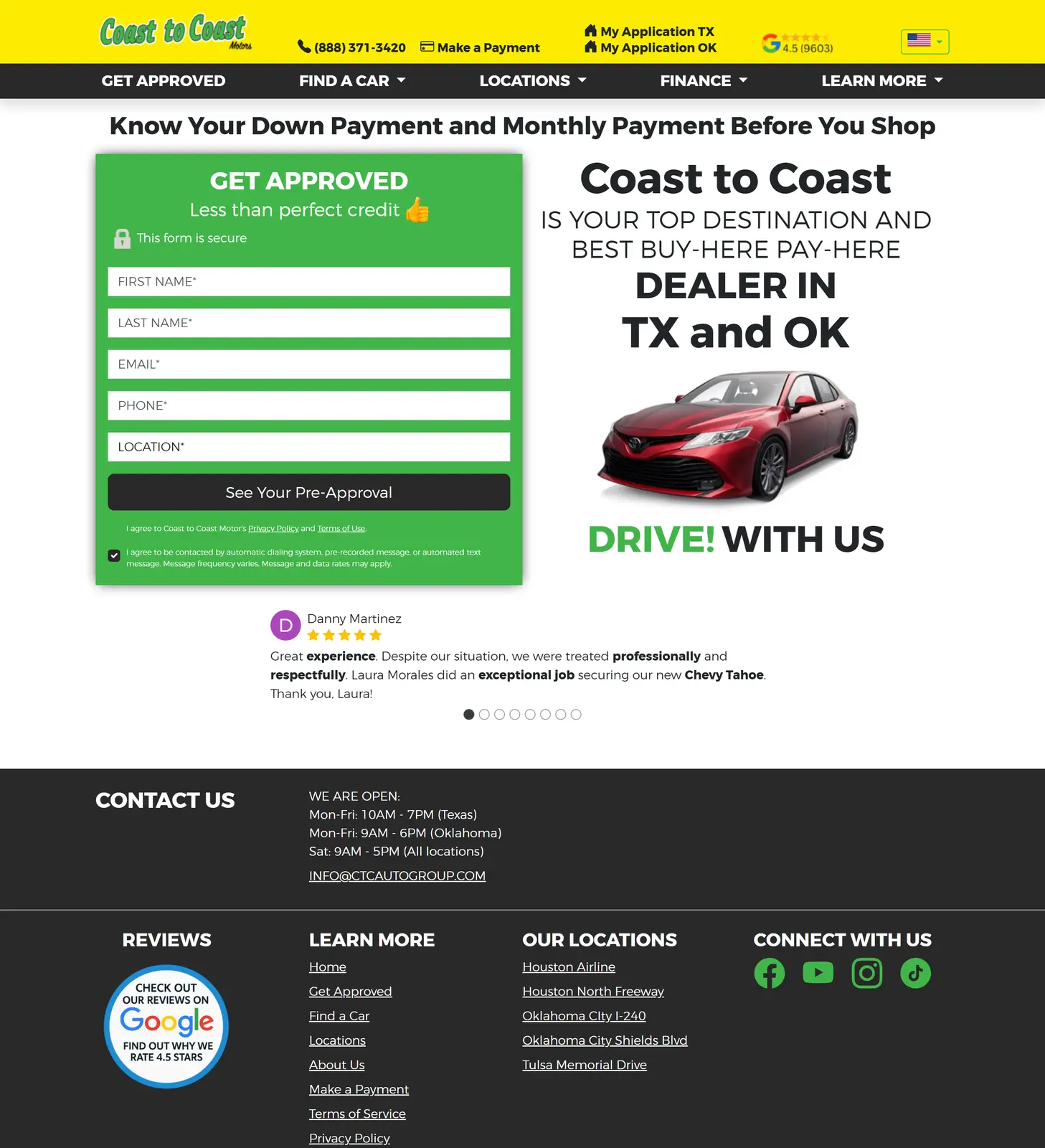
You can see how our in-house financing program structures this, and starting the pre-approval online shortens the in-person time considerably.
How long does in-house financing approval take?
Usually under an hour. A traditional auto loan can take anywhere from a few hours to a few days while the lender pulls credit, verifies documents, and funds the loan. With in-house financing, the dealership is making the decision in real time, so a typical timeline looks like: application (10–15 minutes), document verification (15–30 minutes), and terms review and signing (30–45 minutes). Buyers who complete the online pre-approval first often move even faster.
Why are more Americans choosing in-house financing?
In-house financing has grown because a large share of buyers can't easily qualify for a traditional auto loan, while the price of a dependable used car keeps climbing. For these buyers, a dealership that lends directly is often the only realistic path to a vehicle — and increasingly a deliberate way to rebuild credit at the same time.
The numbers show how big the credit gap has become:
- Subprime buyers are a major share of the used-car market. Subprime borrowers made up 15.31% of all auto financing and 22.47% of used-vehicle financing in Q4 2025, their largest fourth-quarter share since 2021, according to Experian's State of the Automotive Finance Market.
- Roughly 1 in 5 American adults has a credit score of 620 or below — the range most banks treat as subprime — based on 2025 Bankrate analysis. Those buyers face far higher bank denial rates.
- Cars cost more than ever. The average used-car loan now runs about $537 a month on roughly $27,500 financed over a 67-month term (Experian, Q4 2025), pushing standard loans out of reach for many credit-challenged buyers.
- Payment history is the largest credit factor — about 35% of a FICO score, per FICO and Equifax. That's why buyers now actively seek dealers who report payments.
The takeaway: in-house financing is no longer just a last resort. For millions of buyers it's the most practical way to get a reliable car today and a measurably better credit profile tomorrow.
Can you get approved with bad credit or no credit?
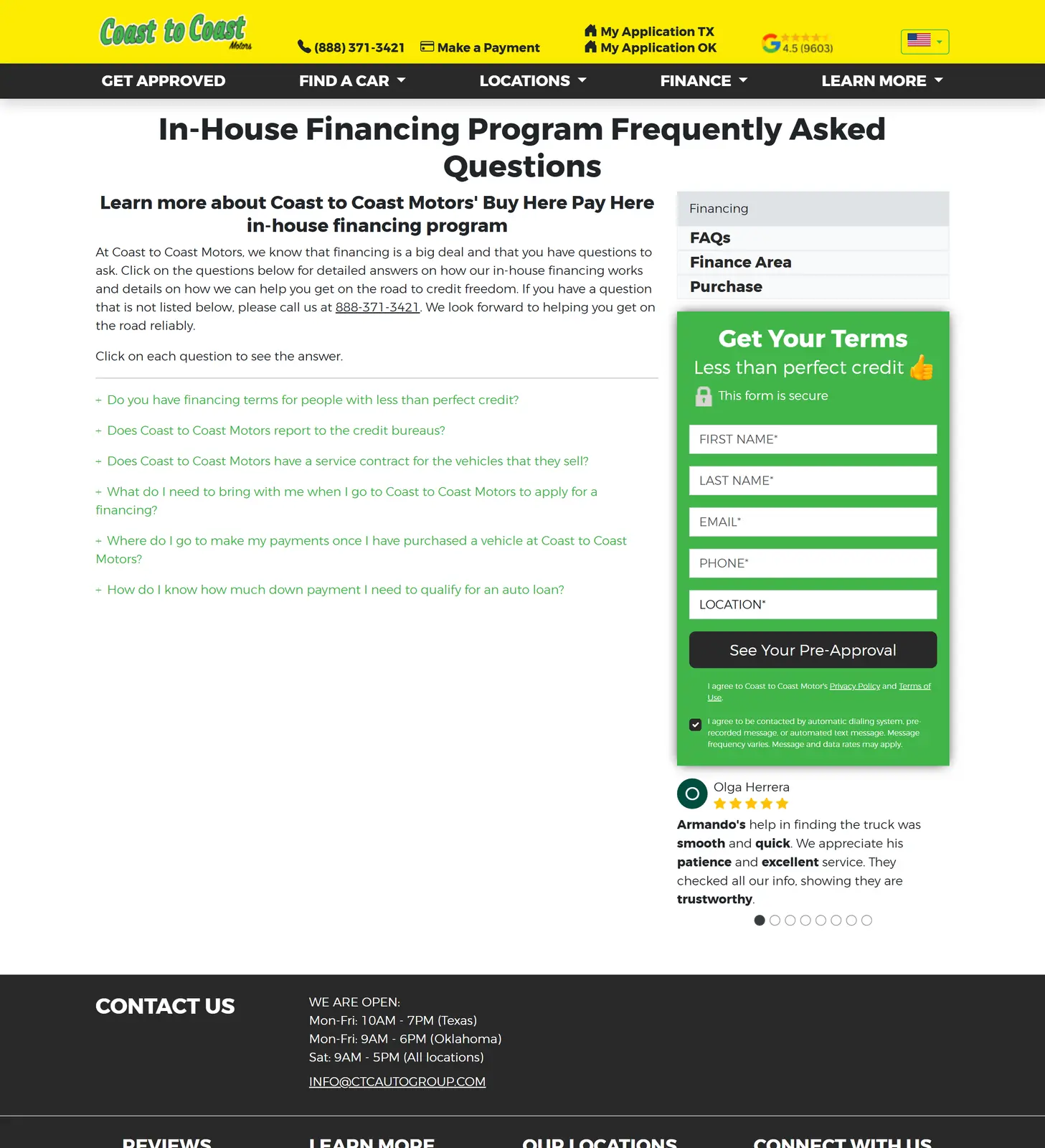
Yes. This is the core reason in-house financing exists. Because the dealership isn't bound by a bank's automated credit cutoff, it can approve buyers that traditional lenders turn away. Coast to Coast Motors, for example, says it specializes in arranging auto loans for people who have had credit problems in the past and can help with almost any credit situation.
Credit still matters, but it isn't the gatekeeper. The dealership weighs your ability to pay today: steady income, time at your job, and the size of your down payment carry more weight than a number from three or four years ago. For reference, Experian defines a "subprime" score as roughly 580–619 and "deep subprime" below 580 — the exact range in-house financing is designed to serve. Buyers with no traditional credit history can often qualify as well, since the decision rests on current income rather than a long credit file.
How payment reporting helps rebuild your credit
Here's the part most buyers don't realize: not every buy-here-pay-here lot reports your payments to the credit bureaus. If a dealership doesn't report, your on-time payments do nothing for your credit score — you pay the loan off and your file looks the same as the day you started.
Dealerships that do report turn the loan into a credit-building tool. Coast to Coast Motors reports payment history to TransUnion every month to help customers rebuild or establish their credit. Over a 12–24 month loan, that consistent history can lift a thin or damaged file meaningfully — and since payment history is the single biggest factor in most credit scores, every on-time payment counts. If rebuilding credit is one of your goals, confirm that the dealer reports, and to which bureau, before you sign.
What documents do you need for in-house financing?
You need less paperwork than a bank requires, and you usually don't need a long credit history. The standard checklist is short and focused on proving you can make the payments.
- Valid government-issued ID (driver's license, state ID, or passport)
- Proof of income — recent pay stubs, or bank statements / 1099s if you're self-employed
- Proof of residence — a utility bill, lease, or mortgage statement in your name
- Proof of a working phone number — sometimes a recent phone bill
- Down payment — cash, debit, or sometimes a trade-in
- References — a few personal references with phone numbers
Some buyers without a Social Security number can finance using an ITIN (Individual Taxpayer Identification Number) at lenders that accept it — confirm acceptance with the dealership before you apply. Having clean, current documents ready is the single biggest factor in getting approved and out the door quickly.
In-house financing vs. traditional auto loans — which is right for you?
Neither option is universally better; they serve different buyers. A traditional loan from a bank or credit union usually offers a lower interest rate, but only if you can qualify. In-house financing trades a higher rate for approval access, speed, and flexibility. The table below breaks down the differences across the factors that matter most.
| Factor | In-House Financing | Traditional Auto Loan |
|---|---|---|
| Approval speed | Often under an hour | Hours to several days |
| Credit requirements | Bad credit or no credit accepted | Typically requires fair-to-good credit (620+) |
| Documentation | ID, proof of income, proof of residence | Full credit pull, income verification, sometimes more |
| Down payment | Required; flexible to your budget | Varies; strong credit may qualify for low or no down |
| Payment flexibility | Schedules that fit your pay cycle; in-person payments | Fixed monthly payment to a bank |
| Interest rate | Higher (reflects the lender's risk) | Lower for qualified buyers |
| Credit rebuilding | Yes, when the dealer reports to a bureau | Yes, reported automatically |
The honest summary: if your credit qualifies you for a bank loan at a reasonable rate, take it. If it doesn't — or if you've been denied — in-house financing gets you into a reliable vehicle now, and at a reporting dealership like Coast to Coast Motors, it can rebuild the credit that gets you a better rate next time.
Pros and cons of in-house financing
Like any financing path, it has real trade-offs. Knowing them up front is what separates a smart purchase from a regretted one.
Pros
- Approval with bad credit or no credit
- Fast approval, often completed in a single visit
- A down payment and payment schedule that can flex to your budget
- A path to rebuild credit when the dealer reports payments
- A simpler, less intimidating process than a bank application
- One place handles the car and the financing
Cons
- Higher interest rates than a prime bank loan
- Vehicle selection is limited to the dealership's inventory
- A down payment is required (this is not a $0-down product)
- Loan terms are often shorter, which can mean larger payments
- The credit benefit only applies if the dealer reports payments
Is in-house financing right for you?
The right financing path depends almost entirely on your credit profile. If you can qualify for a bank or credit-union loan at a fair rate, that's usually the cheaper option; if you can't, in-house financing is what gets you approved. The table below shows the typical best fit by buyer type.
| Buyer profile | Typical credit range | Best-fit financing | Why |
|---|---|---|---|
| Good credit | 720+ | Traditional bank/credit-union loan | Qualifies for the lowest rates; in-house rarely makes sense |
| Fair credit | 620–719 | Bank loan first, in-house as backup | May qualify with a bank, but in-house is faster if denied |
| Bad credit | Below 620 | In-house financing | Banks often deny; in-house approves on income and down payment |
| No credit | No score / thin file | In-house financing | No history to underwrite at a bank; in-house evaluates ability to pay |
| ITIN buyers | No SSN | In-house (where ITIN is accepted) | Most banks require an SSN; some in-house lenders accept an ITIN — confirm first |
A practical rule of thumb: fair-credit buyers should always check a traditional loan first, because the rate will usually be lower. Bad-credit and no-credit buyers are the core fit for in-house financing — and among those, choosing a dealer that reports payments to a bureau is what makes the loan a stepping stone rather than a dead end. You can get pre-approved online to see which terms you qualify for before deciding.
What down payment should you expect?
Plan on a down payment — in-house financing is not a no-money-down product, and any dealer advertising "$0 down" subprime financing deserves a second look. A reasonable down payment protects both you and the dealer, and it lowers the amount you finance and the size of your payments.
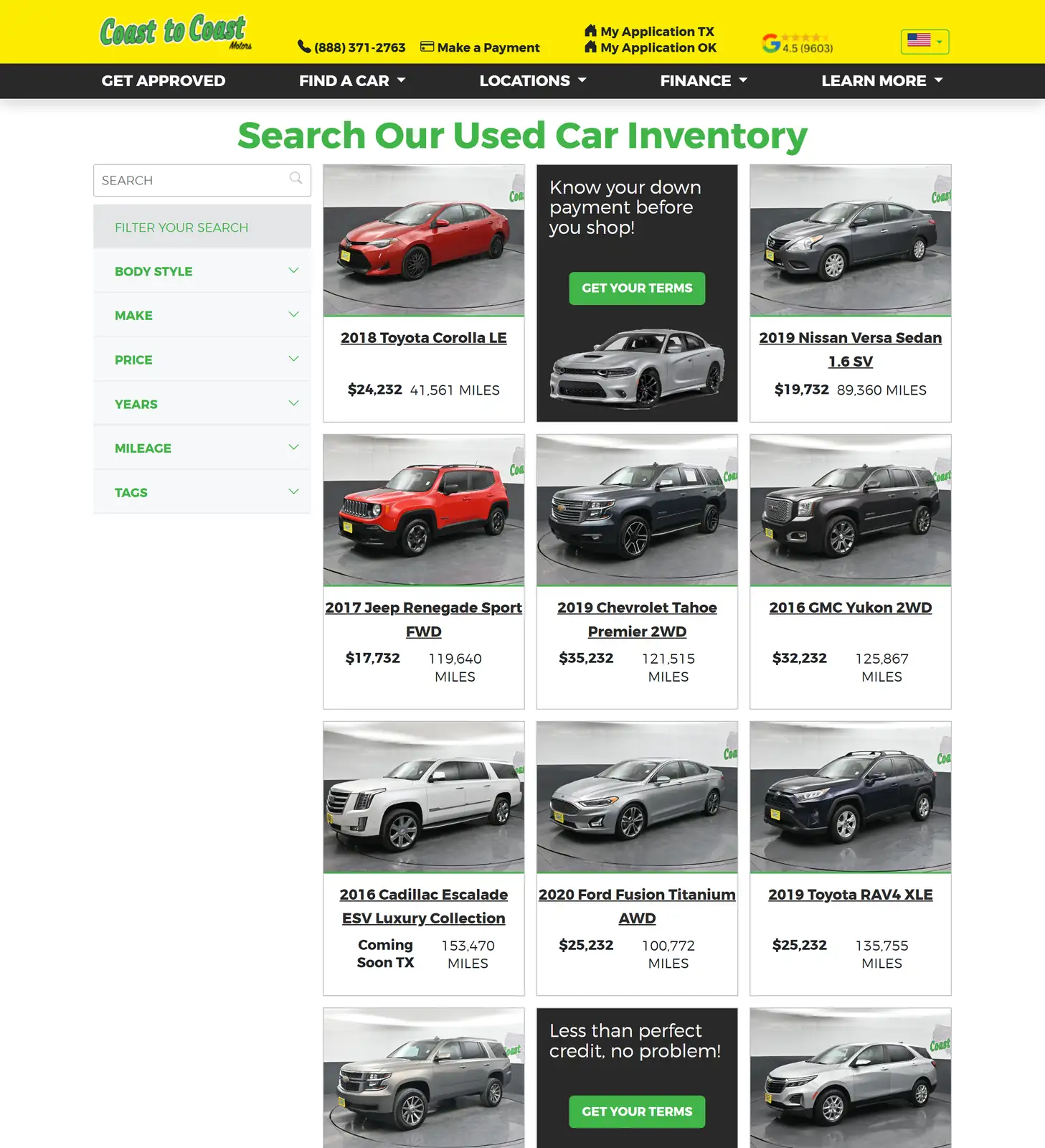
Down payments commonly start around $500 and scale with the vehicle's price and your overall profile. A larger down payment usually unlocks better terms, a wider vehicle selection when you browse the available inventory, and a lower monthly payment, so put down as much as you comfortably can without draining your emergency cushion. A trade-in can count toward your down payment as well.
Common mistakes buyers make with in-house financing
Most problems with in-house financing are avoidable. They come from rushing the decision or focusing on the wrong number. Watch for these:
- Shopping by monthly payment alone. A low monthly payment can hide a long term and a high total cost. Ask for the total amount you'll pay and the interest rate, not just the payment.
- Not asking whether the dealer reports to a credit bureau. This is the difference between a loan that rebuilds your credit and one that doesn't. Ask before you sign.
- Skipping the vehicle inspection. You're buying a used car. Test drive it, and consider an independent inspection on higher-priced vehicles.
- Stretching the budget too thin. A repossession hurts your credit worse than the situation you started in. Choose a payment you can make on your worst month, not your best.
- Ignoring the optional service contract. Used vehicles eventually need repairs. Coast to Coast Motors offers an optional 3-year/36,000-mile service contract with a $250 deductible, for example — weigh coverage deliberately rather than dismissing it.
- Not reading the disclosures. The rate, term, and total cost are disclosed for a reason. Read them, and ask questions until they're clear.
How do you find the best in-house financing dealership near you?
The best in-house financing dealership is one that's transparent about its terms, reports your payments to a credit bureau, and has a solid reputation in your community. Not all buy-here-pay-here lots operate the same way, so a few targeted questions and checks will quickly separate a fair dealer from one to avoid.
Questions to ask before you sign:
- Do you report my payments to a credit bureau, and which one?
- What is the total cost of this loan, including interest — not just the monthly payment?
- What is the interest rate (APR) and the full term?
- What down payment is required, and can a trade-in count toward it?
- Are there payment options that fit my pay schedule?
- Is a service contract available, and what does it cover?
Red flags to avoid:
- A dealer that advertises "$0 down" or "no money down" subprime financing — a legitimate lender expects a reasonable down payment.
- Refusal to put the rate, term, and total cost in writing.
- Pressure to decide on the spot before you've read the disclosures.
- Vague or evasive answers about whether payments are reported.
- Vehicles sold with no opportunity to test drive or inspect.
What to compare before signing: total cost (not the monthly payment), whether the dealer reports to a bureau, the vehicle's quality and history, and the dealer's reputation. Weight reputation heavily — inventory size and quality, and how the dealership treats buyers after the sale, all signal whether you'll be supported through the life of the loan.
How to get the best deal — a buyer's action plan
You have more leverage than you think, especially if you prepare before you walk in. Follow this sequence:
- Check your own credit first so you know where you stand and can spot errors. You're entitled to free reports from the major bureaus.
- Save the largest down payment you reasonably can. It improves your terms and lowers your risk.
- Get pre-approved online to learn your likely terms before you visit — start with our pre-approval form.
- Gather your documents (ID, income, residence, references) so approval goes quickly.
- Set a hard payment ceiling based on your monthly budget and don't exceed it.
- Ask the two key questions: Do you report payments to a credit bureau, and what is the total cost of this loan?
- Inspect the vehicle and review every disclosure before signing.
In-house financing in Houston, TX
In Houston, a car isn't optional. The metro's long commutes and thin public-transit coverage make a dependable daily driver the difference between keeping a job and losing one — and that's exactly the buyer in-house financing serves. Searches like "in house financing houston" and "in house financing car lot near me" come mostly from commuters who've been turned down by a bank but still have to get across town to work.
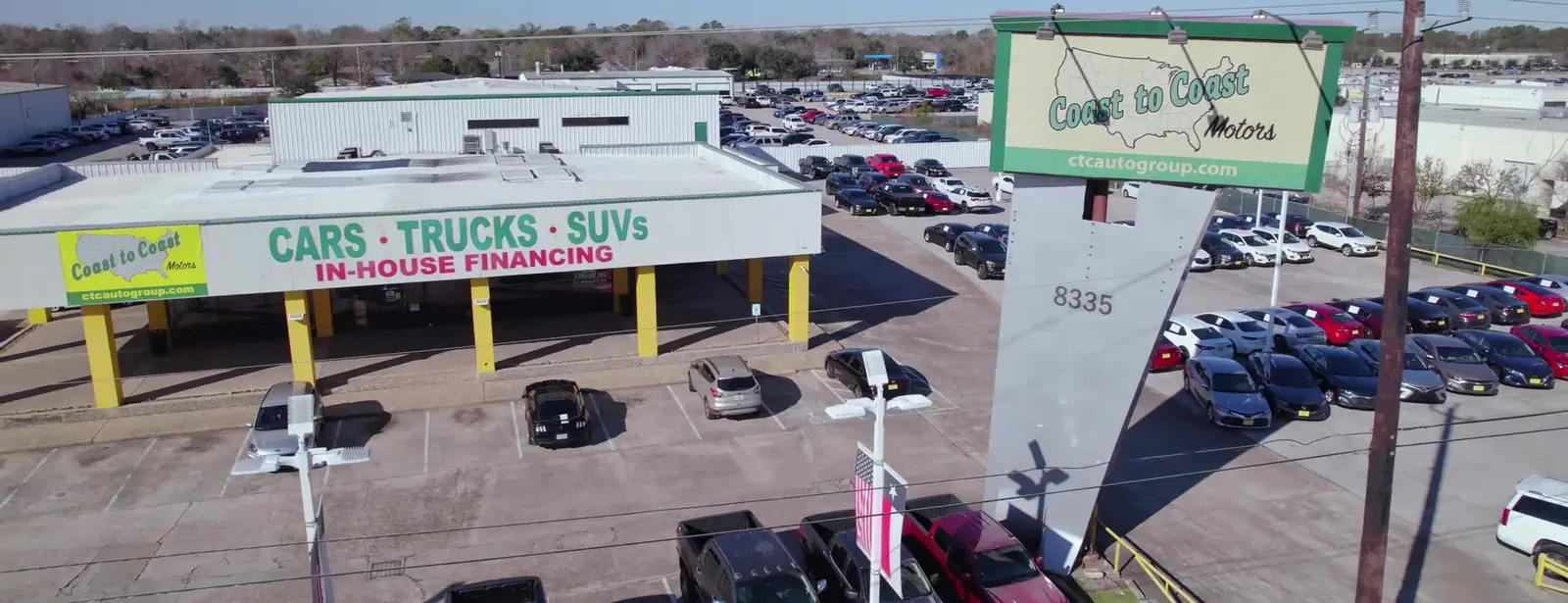
Coast to Coast Motors covers Houston with two stores: the North Freeway location (8335 North Fwy) and the Airline Drive location (8220 Airline Dr). Both work with almost any credit situation and report your payments to TransUnion each month. The team also serves Houston's large Spanish-speaking community in their language, so buyers who've had past credit trouble can apply comfortably and build credit as they pay. You can browse the Houston (Texas) inventory online before stopping in.
In-house financing in Oklahoma City, OK
Oklahoma City spreads across a wide, low-density metro, so the right vehicle has to match how far you actually drive — a fuel-efficient sedan for a cross-town commute, or a truck or SUV for work past the city limits. That makes selection matter as much as approval. Buyers searching "in house finance dealership near me" want a genuine choice of vehicles, not whatever happens to be left on a small lot.
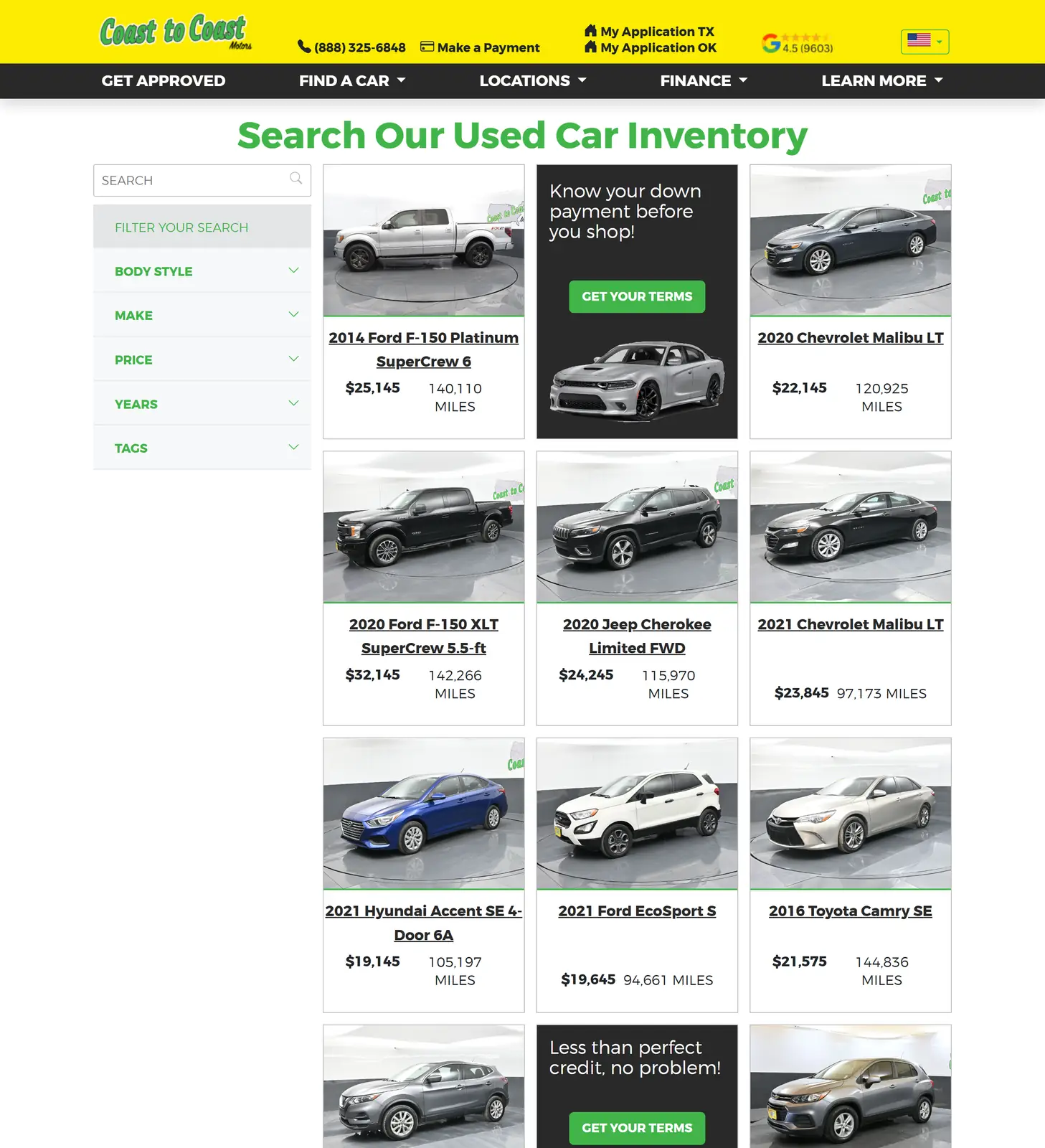
Coast to Coast Motors serves Oklahoma City from two stores, on I-240 and Shields Boulevard, backed by its Oklahoma inventory of over 500 vehicles available online. That breadth lets OKC shoppers match a car to their budget and their drive, qualify on income rather than credit score, and have their payments reported to TransUnion as they go. You can get pre-approved online before visiting either store.
In-house financing in Tulsa, OK
Many Tulsa buyers arrive at Coast to Coast Motors' Memorial Drive store after a "no" somewhere else — a bank, a credit union, or a dealer that only finances clean credit. A past repossession, a thin file, or a bankruptcy doesn't end the conversation here; approval rests on what you can pay now, not what your score was three years ago.
What makes that second chance worth it is the credit rebuilding behind it. Coast to Coast reports your payment history to TransUnion every month, so a Tulsa buyer who was turned away elsewhere can drive a reliable used car and, with each on-time payment, steadily rebuild the credit that triggered the denial in the first place. Browse the full lineup to see what's available before you visit.
Key Takeaways
- In-house financing means the dealership is the lender, so it can approve buyers banks reject.
- Bad-credit and no-credit buyers can qualify based on income and a down payment rather than a credit score.
- Subprime buyers now make up over 22% of used-vehicle financing (Experian, Q4 2025) — you are far from alone.
- Approval is fast — most applications are handled in a single visit.
- Expect a down payment — it's not a $0-down product.
- Ask whether the dealer reports payments. Coast to Coast reports monthly to TransUnion, which turns the loan into a credit-rebuilding tool.
- Compare total cost, not just the monthly payment, and never finance more than your budget can handle.
Ready to see what you qualify for?
A quick online pre-approval shows your likely terms in minutes, with no obligation. Bring your ID, proof of income, and proof of residence, and you can finish at the store the same visit.
Frequently Asked Questions
What is in-house financing?
In-house financing is a car loan provided directly by the used car dealership instead of an outside bank or credit union. The dealership approves you, sets your terms, and collects your payments, which lets it work with buyers who have credit challenges.
How does in-house financing work?
You apply at the dealership, verify your income and residence with a few documents, choose your vehicle and down payment, review your terms, and drive away. Because there's no external lender, the dealership makes the decision on the spot, often the same visit.
Can I get approved with bad credit?
Yes. In-house financing is specifically designed for buyers with bad credit. Approval is based largely on your current income, job stability, and down payment rather than your credit score, so past credit problems are not an automatic denial. Coast to Coast Motors says it can help with almost any credit situation.
Can I finance a car with no credit?
Yes. Buyers with no credit history can qualify, because the dealership evaluates your ability to pay now instead of relying on a credit file.
Can I get financed with an ITIN instead of a Social Security number?
Some in-house dealerships accept an ITIN (Individual Taxpayer Identification Number) in place of a Social Security number, though policies vary by lender. If you don't have an SSN, ask the dealership directly whether it can finance with an ITIN before you apply.
What documents do I need for financing?
You typically need a valid government ID, proof of income (pay stubs or bank statements), proof of residence (a utility bill or lease), a working phone number, references, and your down payment. Having these ready speeds up approval.
How long does financing approval take?
Usually under an hour, and faster still if you complete the online pre-approval before you visit.
Is in-house financing better than a bank loan?
It depends on your situation. A bank loan usually has a lower interest rate, but only if your credit qualifies. In-house financing offers approval access, speed, and flexibility for buyers banks turn down — and at a reporting dealer, it can rebuild the credit you need to qualify for a bank loan later.
How much down payment do I need?
A down payment is required — in-house financing is not a $0-down product, and any "no money down" subprime offer is a red flag. Down payments commonly start around $500 and rise with the vehicle's price and your profile. A larger down payment lowers your monthly payment and usually improves your terms, and a trade-in can count toward it.
Will in-house financing actually improve my credit score?
It can, but only if the dealership reports your payments to a credit bureau. Coast to Coast Motors reports payment history to TransUnion every month, so each on-time payment builds positive history. Since payment history is the largest factor in most credit scores, a 12–24 month loan can meaningfully improve a thin or damaged file.
Sources
- Experian — State of the Automotive Finance Market (Q4 2025 subprime share; average used-car loan figures)
- Consumer Financial Protection Bureau — Auto loans
- FICO — What's in your credit score (payment history = 35%)
- Equifax — What is a FICO Score
- TransUnion — Credit score basics
- Bankrate — credit score / subprime analysis, 2025
- NIADA — National Independent Automobile Dealers Association