This guide covers what your score does, what matters just as much, and how buyers with a 500, a 600, or no credit still drive home financed.

Quick Answer
There is no single credit score you need to buy a car. Buyers finance from the 800s down into the 500s and even with no score. A higher score earns a lower interest rate, not the right to be approved. Approval also rests on your income, employment, residence stability, debt-to-income ratio, and down payment. Most banks want roughly 660+ for their best pricing, subprime lenders approve well into the 500s, and a dealership that finances in-house, like Coast to Coast Motors, can approve buyers on income and stability when a bank's automated system says no. You can get pre-approved online to see where you stand before visiting a lot.
Key Takeaways
- No required score exists. There is no legal minimum; every lender sets its own cutoff.
- Your score sets your rate, not your fate. It drives the interest rate, but approval is a whole-application decision.
- A strong application can outweigh a weak score. Income, stability, and a down payment often matter as much as the number itself.
- 500 and 600 are financeable through subprime and in-house lenders, at a higher rate.
- No score is not a dead end. In-house financing can approve a blank file on income, and the loan then builds credit.
- A recent repossession outweighs an old late payment: lenders read recency and severity, not just the number.
- Improve your odds before applying: pay down cards, save a bigger down payment, and rate-shop in one window.
What credit score do you need to buy a car?
There is no specific credit score you need to buy a car, and no legal or industry-wide minimum. Each lender sets its own line, so your score decides how much you pay in interest far more than whether you get a yes. A strong score earns a low rate; a weak one changes who lends to you and on what terms, not whether anyone will. That is why a buyer at 720 and one at 540 can leave with the same car on different loans.
The Consumer Financial Protection Bureau treats your score as one of several factors, and its data shows auto loans originated across every score band, including below 580. What looks like a "minimum" is really each lender drawing its own line: banks and manufacturer lenders mostly want about 660 and up; credit unions often start near 620; subprime companies approve roughly 500 to 660 at higher rates; and in-house dealers set no score floor at all. So the honest answer depends entirely on where you apply. Match yourself to the right kind of lender instead of guessing whether you clear a bar that isn't there, and almost no one is truly shut out; the real question is which door you walk through and what the loan costs once you are inside.
Credit score ranges explained
Credit scores run from 300 to 850 and fall into five bands, from Poor to Exceptional. Your band signals how lenders are likely to view you and roughly what rate to expect.
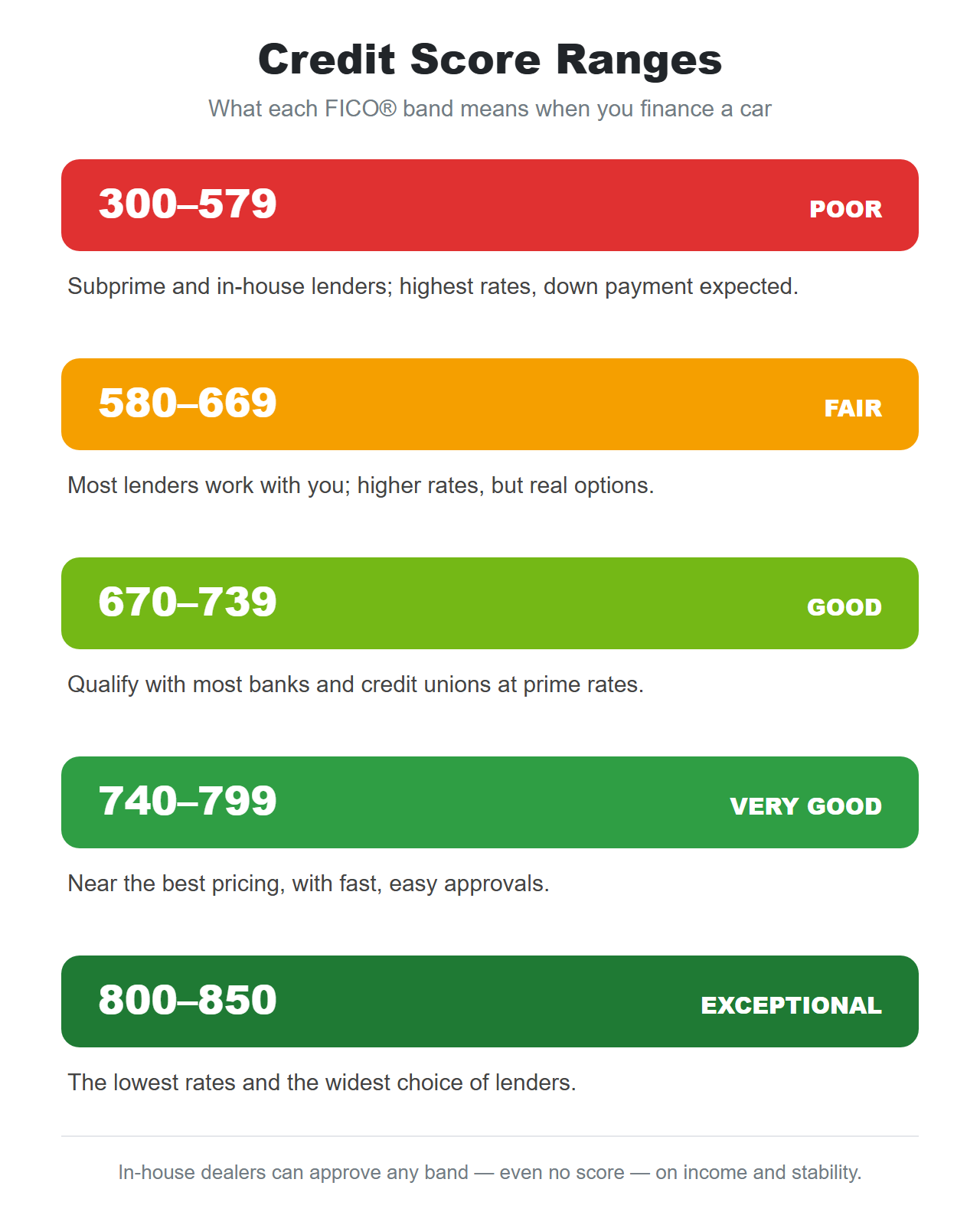
Rate is where the band bites, and recent Experian data shows how wide the spread runs on used-car APRs:
| Credit tier | Score range | Avg. new-car APR | Avg. used-car APR |
|---|---|---|---|
| Super prime | 781–850 | ~4.7% | ~7.7% |
| Prime | 661–780 | ~6.3% | ~10.0% |
| Near prime | 601–660 | ~9.6% | ~14.5% |
| Subprime | 501–600 | ~13.2% | ~19.4% |
| Deep subprime | 300–500 | ~16.0% | ~21.9% |
On a typical used vehicle, the gap between the top tier and the bottom is thousands of dollars over the life of the loan. One caveat: the bands use FICO® while the rate tiers use VantageScore, so cutoffs differ slightly and you hold more than one score. Think in bands, not one number.
What lenders actually look at besides your score
A lender is really answering one question: can you make this payment reliably for the life of the loan? Six other factors feed the decision, and a strong showing across them can outweigh a weak score.
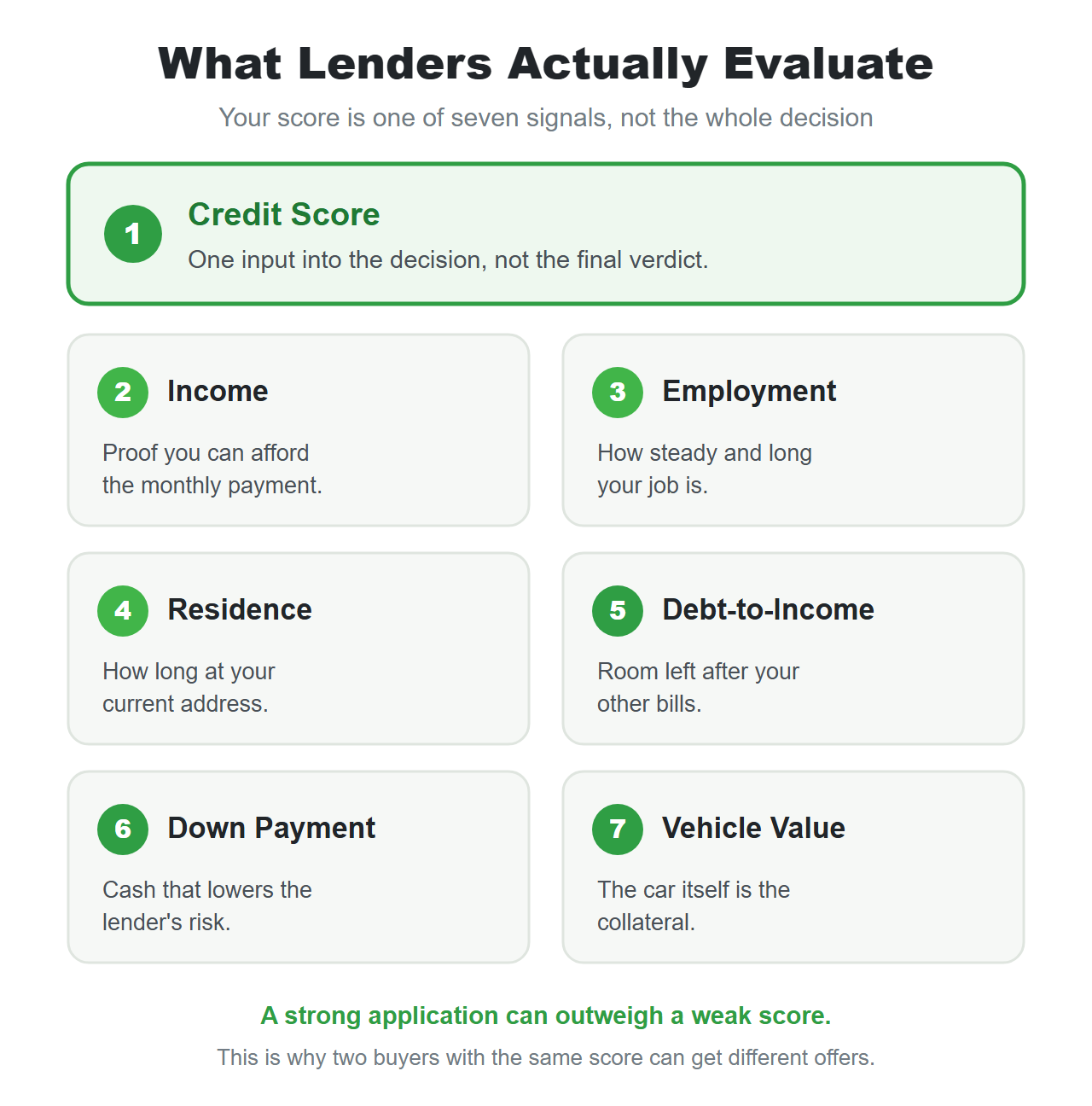
Of those six, income does the heaviest lifting, because it answers the only question that matters: can you make the payment? That is why a dealership can approve someone a bank's software rejected. Documented income and a stable address are exactly the proof it needs, score or no score, and the CFPB recommends gathering those documents before you shop.

Why two buyers with the same score get different offers
Two people can walk in with an identical 640 and leave with very different loans. The score is the same, but the rest of the application is not. Picture two buyers, both at 640, both wanting the same $18,000 used SUV:
| Buyer A | Buyer B | |
|---|---|---|
| Credit score | 640 | 640 |
| Income | $5,200/mo, 3 years at job | $3,000/mo, 4 months at job |
| Existing debt | Low (one small loan) | High (cards near their limit) |
| Down payment | $3,000 | $500 |
| Likely outcome | Approved at a better rate | Higher rate, or asked for more down |
Same score, different risk. Buyer A's stability and money down read as a safe bet, while Buyer B's thin margins push the rate up or the down payment higher. Two details inside the report work the same way:
- A recent repossession outweighs an old late payment. A repossession stays on your report for seven years, but its sting is heaviest early. A missed payment from four years ago barely registers, while a repossession from six months ago signals active trouble.
- Debt-to-income can quietly decide a borderline file. Many auto lenders want total monthly debt under about 45–50% of gross income, and subprime lenders often cap the car payment alone near 15–20% of income.
The good news: down payment, debt-to-income, and the car you choose are all still in your control. You cannot fix your score by Saturday, but more money down or a cheaper car moves a borderline file into approval.
Can you buy a car with a 500 credit score?
Yes, you can buy a car with a 500 credit score, though your options narrow and your rate rises. A 500 sits in the deep-subprime range, so most banks decline, while subprime finance companies and in-house dealerships work with 500-level buyers routinely. At this score the lender assumes real damage in your history, so the application leans on everything else:
- A meaningful down payment shrinks the loan and is often the difference between a yes and a no.
- Documented, steady income carries the decision when the score cannot.
- A sensibly priced vehicle is far easier to finance than a big, expensive one.
Expect a higher rate, but treat it as temporary: after about a year of on-time payments, many 500-level buyers refinance lower. If your score is low from past credit trouble, our state guides on buying a car with bad credit in Texas and in Oklahoma go deeper.
Can you buy a car with a 600 credit score?
Yes, and a 600 opens noticeably more doors than a 500. At 600 you are in the near-prime range, so more lenders compete for you, including some credit unions and dealer financing, not just subprime specialists. Your focus shifts from "will anyone approve me?" to "who gives me the best rate?" So shop, not settle:
- Collect more than one offer so you can compare real terms side by side.
- Push toward 620 or 640 first if you can. Even 20 or 30 points can drop your rate a tier, and paying a card below its limit before you apply is often enough to get there.
- Put your down payment to work. At 600 it does more than win approval; it gives you room to negotiate a better rate.
Treat 600 as a rate problem, not an approval problem: you are close enough to prime that small pre-application improvements save real money over the loan.
Can you buy a car with no credit score?
Yes. Having no credit score is different from having a bad one, and it is often easier to finance. A blank file has nothing negative in it, so an in-house lender only needs to confirm you can afford the payment. First-time buyers, recent graduates, new arrivals, and lifelong cash payers all fall here, and because that first reported loan starts your credit history, it doubles as a credit builder. Buyers who file taxes with an ITIN instead of a Social Security number can qualify at dealers that accept it, Coast to Coast Motors included. Since this is its own situation, we cover the documents and steps in a dedicated guide: Can You Buy a Car With No Credit?
How in-house financing evaluates buyers differently
In-house financing means the dealership is the lender, approving and servicing the loan itself instead of routing it to an outside bank. That is why it can approve scores and files a bank's software rejects on sight.
| Bank / credit union | In-house financing | |
|---|---|---|
| Who decides | An outside underwriter's model | The dealership itself |
| Main driver | Your credit score | Your income and stability |
| Low or no score | Often an automatic decline | Evaluated case by case |
| Speed | Can take days | Often same-day |
| Best fit for | Strong-credit buyers chasing the lowest rate | Fair, poor, rebuilding, or no-credit buyers |
One caveat: not every in-house lot is equal. The most important question to ask is whether the dealer reports your payments to a credit bureau, because an unreported loan cannot build your credit no matter how well you pay it. Coast to Coast Motors reports to TransUnion monthly, so on-time payments rebuild your score while you drive. Our guide to how in-house financing works explains the full model and how to vet a lot.

How to improve your approval chances before applying
You can meaningfully improve your odds in the weeks before you apply, without waiting years for a higher score. Some moves lift the score itself; others strengthen the rest of the application.
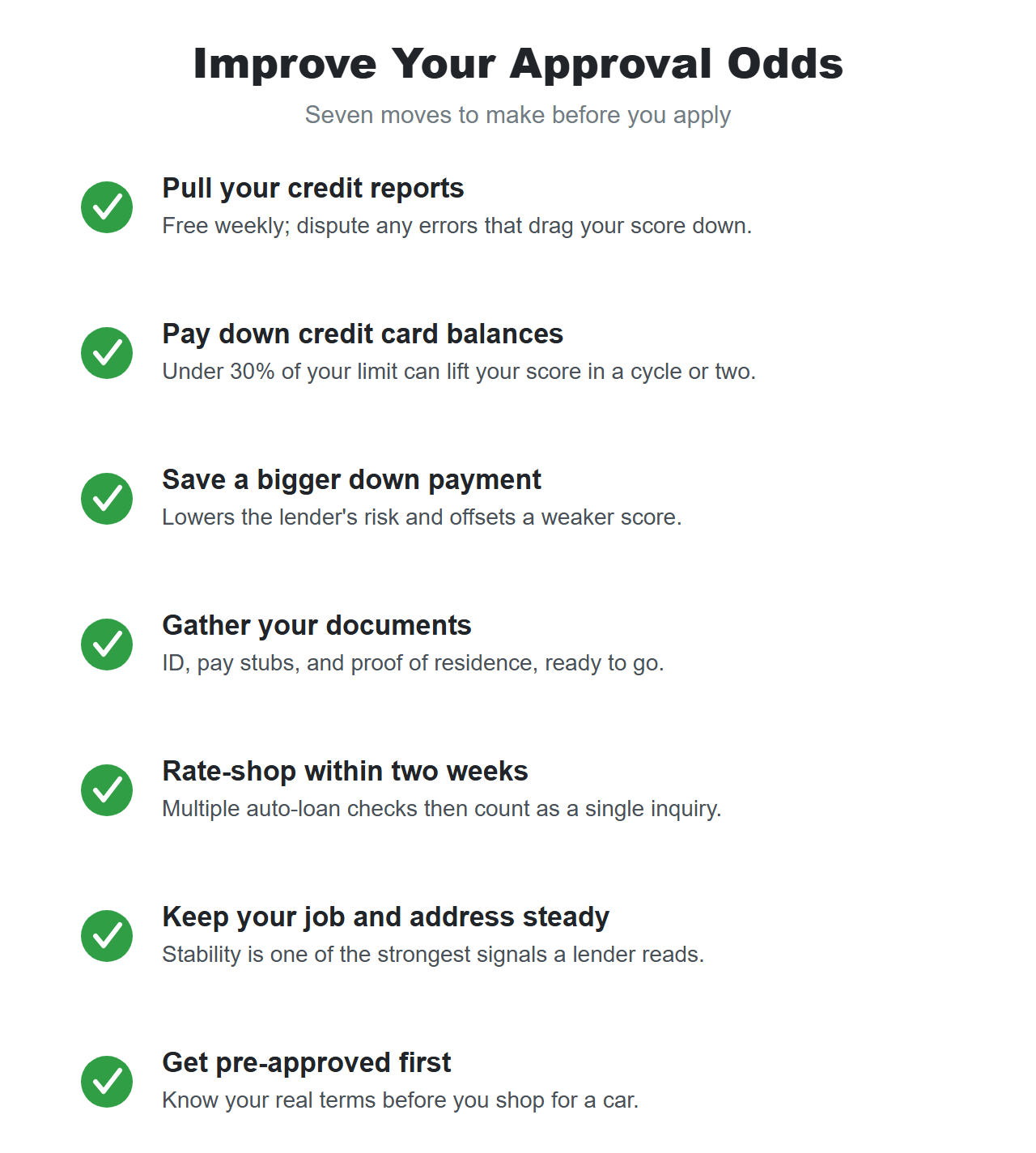
Three of these move the needle most. Paying down credit card balances works fastest, because amounts owed are 30% of your FICO score (second only to payment history at 35%), so dropping under 30% of your limit can lift your score within a cycle or two. Rate-shopping inside a two-week window matters nearly as much, since the scoring models fold multiple auto-loan inquiries into one. And fixing a single error on the reports you can pull free each week sometimes helps more than months of careful paying. The CFPB and Equifax publish free credit guides.
Which financing path fits you?
The fastest way to find your route is to work from what you can prove, not from your score alone. Begin with income and stability, then your credit, and the right path falls out.
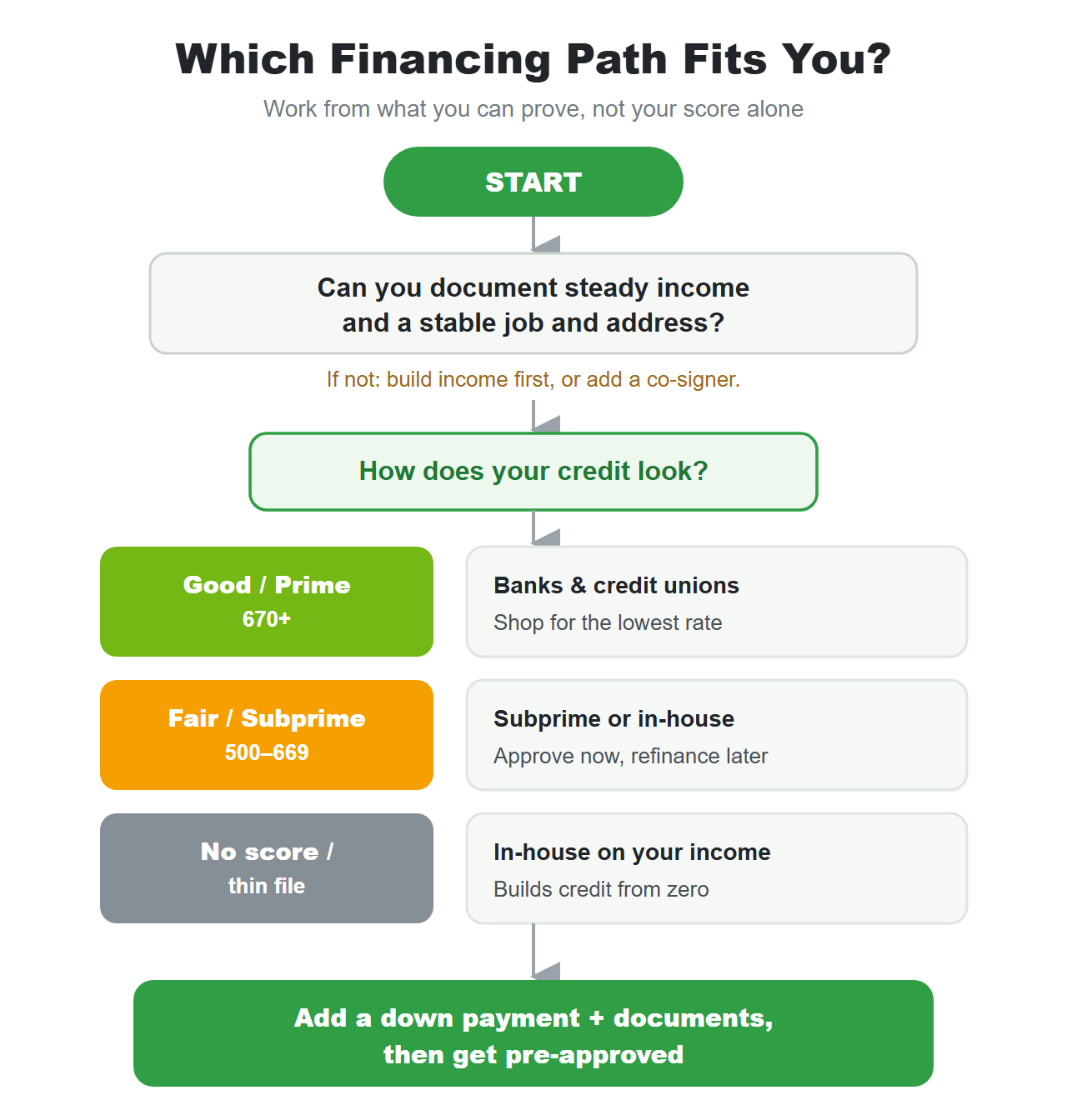
Wherever it lands you, the last steps are the same: bring a down payment and documents, then get pre-approved. First, a few questions keep you comparing loans fairly:
| Question to ask | Why it matters |
|---|---|
| Do you report payments to a credit bureau? | Only a reported loan builds your credit |
| What is the APR, not just the monthly payment? | A low payment can hide a high rate and long term |
| What is the total cost over the full loan? | Shows the real price, interest included |
| What down payment do you require? | Lets you plan and compare offers accurately |
| Can I refinance later without a penalty? | Keeps the door open once your score improves |
Not sure which path is yours?
A quick online pre-approval shows your likely terms in minutes, with no obligation and no bank denials on your record.
Common myths about credit scores
A handful of stubborn myths talk otherwise-ready buyers out of applying. Here is what is actually true.
| Myth | Fact |
|---|---|
| "Checking my credit score will lower it." | Checking your own score is a soft inquiry and never affects it. Only a lender's hard pull can, and usually by less than five points. |
| "I need to reach 700 before I can buy a car." | The average used-car buyer finances below 700. Deals close in every band, including the 500s and with no score. A higher number lowers your rate; it is not an entry ticket. |
| "Carrying a credit card balance builds my score faster." | No. You build credit by paying on time and keeping balances low. Carrying a balance just costs interest and can raise utilization. |
| "My spouse and I share one credit score." | Credit is individual. You each have your own score and report. On a joint auto loan a lender may consider both, which helps if one of you is stronger. |
Buying a car with any credit score in Texas and Oklahoma
None of this is state-specific, but if you are shopping in Texas or Oklahoma, here is where to start. Coast to Coast Motors runs five stores across three metros: Houston (North Freeway and Airline Drive), Oklahoma City (I-240 and Shields Boulevard), and Tulsa (Memorial Drive), each built on the idea that income and stability matter as much as your score.

With 500-plus vehicles company-wide, you can match a car to your budget instead of settling for the only thing on a small lot. Browse the full inventory, view the Texas or Oklahoma selection, review financing options, get pre-approved, or reach out to the team at any of the five locations.
Frequently Asked Questions
What credit score do you need to buy a car?
No single score is required. Buyers finance from the 800s down to the 500s and even with no score, so approval also weighs your income, employment, stability, debt-to-income ratio, and down payment, not the score alone.
What is the minimum credit score to buy a car?
None. Each lender sets its own cutoff: many banks want about 660 or higher for their best rates, subprime lenders approve into the 500s, and in-house dealers can approve very low or no scores on income and stability.
Can I get a car loan with a 500 credit score?
Yes. Banks usually decline a 500, but subprime and in-house lenders finance this deep-subprime level routinely. Expect a higher rate and a down payment; steady documented income and a modestly priced vehicle improve your odds.
Does checking my own credit score lower it?
No. Checking your own score or report is a soft inquiry and never affects it, so check as often as you like. Only a lender's hard inquiry lowers your score, usually by less than five points.
How much does my credit score affect my car loan interest rate?
A lot. On used cars, recent Experian data shows super-prime borrowers near 7.7% APR and deep-subprime borrowers near 22%, a gap that adds hundreds to the monthly payment and thousands in interest over a typical loan.
Will getting pre-approved for a car loan hurt my credit?
Barely. A hard inquiry costs a few points at most, and multiple auto-loan checks within about two weeks count as one. Knowing your real terms before you shop is worth far more than the small, temporary dip.
How long does a repossession stay on my credit report?
Seven years, counted from the first missed payment that led to it. Its impact is heaviest early and fades with age, so a recent repossession weighs far more against a new application than an old one.
Can I refinance my car loan after my credit improves?
Yes. If a low or missing score gave you a high rate, you can often refinance lower after about 12 months of on-time payments, as long as your original lender reported the loan so your score could grow.
Does income matter more than my credit score for a car loan?
Often, yes. A score predicts how you have handled debt; income proves you can afford the payment now. In-house lenders lead with income, employment, and residence stability, so steady documented earnings can carry a low-score application.
Sources
- Consumer Financial Protection Bureau — Auto loans and how rate-shopping affects your credit
- Experian — Credit score ranges, average auto-loan rates by credit score, and how long a repossession stays on your report
- myFICO — What's in your credit score (payment history 35%, amounts owed 30%) and rate-shopping windows
- Bankrate — Average car loan interest rates by credit score
- Equifax — Understanding your credit score
- TransUnion — Credit score basics
- Federal Trade Commission — Financing or leasing a car
- NIADA — National Independent Automobile Dealers Association