This guide explains exactly how dealerships evaluate first-time buyers, what documents you'll need, how much to expect for a down payment, whether you need a co-signer, and how your first auto loan can start building your credit from day one.

Quick Answer
Yes, you can buy a car with no credit. The key is applying with a dealership that offers in-house financing rather than relying on a traditional bank. In-house lenders approve you on your current income, job and residence stability, and down payment instead of a credit score, so first-time buyers, recent graduates, immigrants, and lifelong cash payers can all qualify. Expect to bring a valid ID, proof of income, proof of residence, and a down payment that commonly starts around $500. Choose a dealer that reports payments to a credit bureau, such as Coast to Coast Motors, which reports monthly to TransUnion throughout Texas and Oklahoma, and every on-time payment starts building the credit you did not have. You can get pre-approved online before you ever visit a lot.
Key Takeaways
- No credit is not bad credit. A blank file has nothing negative in it, so it is often easier to finance than a damaged one.
- Income beats score. In-house lenders approve on your ability to pay now, which is exactly what a no-credit buyer can prove.
- A down payment is expected, commonly starting around $500. Treat any "$0 down, no credit" pitch as a warning sign.
- You usually do not need a co-signer for in-house financing, though one can help a very thin or low-income application.
- An ITIN works in place of a Social Security number at dealers that accept it, opening approval to buyers without an SSN.
- Your first car loan builds credit as long as the dealer reports payments. Coast to Coast reports to TransUnion every month.
- Come prepared: a valid ID, recent pay stubs, proof of where you live, references, and your down payment can get you approved in a single visit.
Can you buy a car with no credit?
Yes. You can finance a car with no credit history by using in-house financing, where the dealership is the lender and approves you on income and stability rather than a credit score. There is no law that requires a credit score to buy a car, and there is no minimum score for a lender that does not rely on one.
The reason no credit feels like a wall is that most bank and credit-union auto loans run your application through an automated model. That model needs a score to predict risk, and when it finds an empty file it usually returns a denial by default. It is not judging you as risky; it simply has nothing to read.
A dealer that finances in-house removes that dead end. Instead of feeding your file to an outside underwriter, the dealership makes the decision itself, looking at whether you can comfortably afford the payment today. That shift is why a first-time buyer with two pay stubs and a modest down payment can get approved on the same afternoon a bank's system said no. Coast to Coast Motors arranges in-house financing for exactly this situation across its Texas and Oklahoma stores and can work with almost any credit background, including none at all.
No credit vs. bad credit vs. thin credit file
Before anything else, it helps to know which situation you are actually in, because lenders treat all three differently. People lump them together, but they are not the same problem.
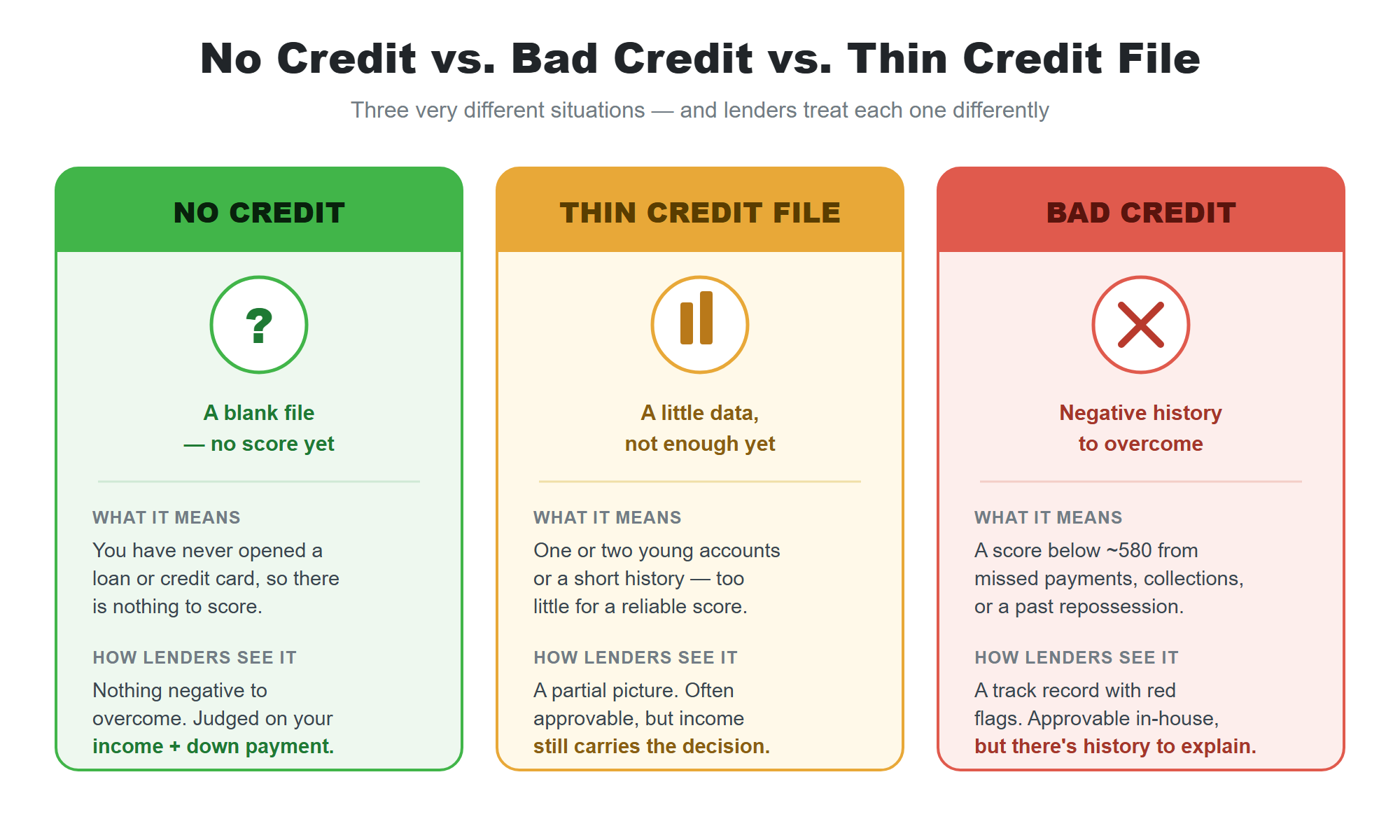
- No credit means you have never opened a loan or credit card, so the bureaus have nothing to score. The file is blank. There is nothing negative to explain, and nothing positive yet either.
- A thin credit file means you have one or two young accounts, or a short history, but not enough activity for the scoring models to produce a reliable number. You might see a score one month and none the next.
- Bad credit means you have a track record, and it includes red flags: missed payments, accounts in collections, or a past repossession. There is history here, and it works against you.
The distinction matters because it changes how a lender reads your application.
| Situation | What the bureau sees | How a lender reads it | Typical best path |
|---|---|---|---|
| No credit | No score, no accounts | A clean slate — nothing to hold against you | In-house financing on income |
| Thin file | 1–2 young accounts, low activity | A partial picture, usually workable | In-house financing on income |
| Bad credit | A score, usually below 580, with negatives | Real risk signals to overcome | In-house or subprime financing |
If your situation is bad credit rather than no credit, the playbook is different, and we cover it in depth in our guides to buying a car with bad credit in Texas and buying a car with bad credit in Oklahoma. For the rest of this guide, we are focused on the buyer whose file is blank or nearly so.
Is no credit better than bad credit?
In most financing conversations, yes, no credit is the easier starting point. The difference is what the lender has to react to: bad credit hands them a documented reason to hesitate, while no credit hands them a blank page.
That blank page is why a no-credit application often moves faster than a bad-credit one with identical income. There is no repossession or collection to explain away, so the review is shorter and the back-and-forth is smaller. The one place bad credit occasionally has the edge is data, since a low score is still a score, and a few lenders would rather read a shaky history than none at all.
What no credit does not buy you, though, is a prime interest rate. With no track record, you are still priced as a higher-risk borrower, so expect a rate above what someone with established credit would get on the same car. That is the honest trade-off: no credit rarely blocks approval the way bad credit can, but it does not unlock the cheapest money either. The rest of this guide is about turning that blank page into a positive one so your next loan is cheaper than this one.
Why lenders actually like some no-credit buyers
Here is something dealers rarely say out loud: a no-credit buyer with a steady job can be a genuinely good customer, not a risk they merely tolerate. It comes down to two kinds of math.
The first is risk math. A first-time buyer who is employed and carries no other loans has a clean debt-to-income picture, which is one of the numbers a lender cares about most. Nothing else is competing for that paycheck, and there is no record of walking away from a debt. Set that next to a deep-subprime applicant carrying years of old damage, and the no-credit file is frequently the safer bet, score or no score.
The second has nothing to do with this loan at all. A dealer that finances your first car and reports it is, in effect, issuing your first credit history, and buyers remember who did that. In a business that runs on repeat purchases and referrals, the first-time buyer approved today is the trade-in next year, the second car after that, and the coworker sent through the door. Independent dealers, the segment represented by the National Independent Automobile Dealers Association (NIADA), built the in-house model around this exact customer, which is why having no credit puts you in their core market rather than at the back of the line.
How dealerships evaluate buyers with no credit
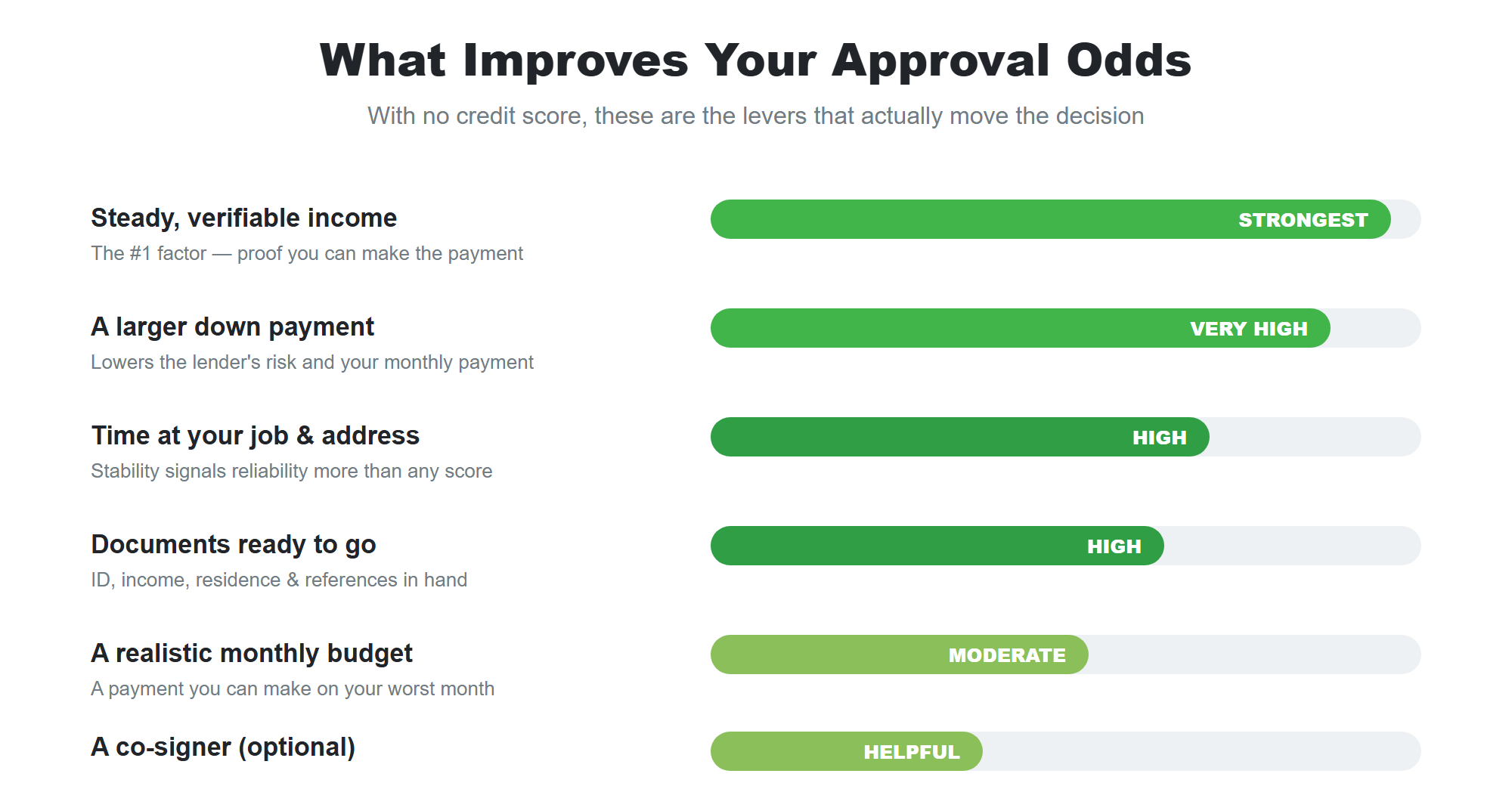
Without a score to lean on, an in-house lender evaluates whether you can afford the payment and whether your life is stable enough to keep making it. The credit score is replaced by a handful of practical signals.
Here is what actually goes into the decision:
- Income. How much you earn and how reliably. This is the single biggest factor, because it answers the only question that matters: can you make the payment?
- Job stability. How long you have held your job. Two years at one employer carries more weight than a higher salary you started last week.
- Residence stability. How long you have lived at your address. Staying put signals reliability.
- Down payment. How much you can put down. A larger down payment lowers the lender's risk and shows commitment.
- Debt you already carry. Your existing obligations versus your income, so the lender knows the new payment fits.
- References. A few people who can vouch for you, which helps when there is no credit history to reference.
Notice what is not on that list: a three-digit number that says nothing about whether you show up to work. This is why income often matters more than a score for a no-credit buyer. A score is a prediction of behavior; income is proof of ability. When you can document steady earnings and a stable address, you are handing the lender the exact evidence it needs to say yes.

What documents you'll need
Bring a valid ID, proof of income, proof of residence, references, and your down payment. The list is short because in-house financing is built around verifying that you can pay, not digging through years of financial history.
Have these ready before you apply:
| Document | Examples | Why it matters |
|---|---|---|
| Government-issued ID | Driver's license, state ID, passport | Confirms who you are |
| Proof of income | Two recent pay stubs, bank statements, or 1099s if self-employed | Shows you can make the payment |
| Proof of residence | Utility bill, lease, or mortgage statement in your name | Confirms stability and address |
| Working phone number | A recent phone bill, sometimes | Contact and added stability signal |
| Personal references | A few names and phone numbers | Stands in for a credit history |
| Down payment | Cash, debit, or a trade-in | Lowers risk and improves your terms |
| SSN or ITIN | Either works at dealers that accept an ITIN | Identifies you for the loan |
The single biggest thing you control here is preparation. Walking in with current, matching documents lets the dealer verify you quickly and often finish the same visit. The Consumer Financial Protection Bureau recommends gathering income and residence documentation before you shop, because it lets you compare real terms instead of rough estimates.
No Social Security number? An ITIN (Individual Taxpayer Identification Number) can be used in place of an SSN at dealers that accept it. Coast to Coast Motors accepts an ITIN, which opens approval to many first-time buyers in Houston's and Oklahoma City's Spanish-speaking communities who file taxes with an ITIN rather than an SSN.
How much down payment should you expect?
Plan on a down payment. For no-credit buyers it commonly starts around $500 and rises with the vehicle's price. A down payment is normal and expected; it lowers the amount you finance, reduces your monthly payment, and gives you immediate equity in the car.
There is a reason every credible in-house lender asks for money down. It lowers the risk for both sides and shows you have a stake in the loan from day one. That is also why you should be cautious with any dealer advertising "$0 down" or "no money down" for a no-credit buyer. A legitimate lender expects a reasonable down payment, and an offer that skips it usually hides a weak deal or a vehicle that will not last. Coast to Coast Motors requires a down payment, with flexible options that start low so the upfront cost stays realistic.
Here is how the amount you put down changes a typical $12,000 vehicle:
| Down payment | Amount financed | Effect on your loan |
|---|---|---|
| $500 (minimum) | $11,500 | Lowest upfront cost; higher monthly payment |
| $1,500 | $10,500 | Noticeably lower monthly payment; stronger application |
| $2,500+ | $9,500 or less | Smallest payments; widest vehicle selection; lowest total cost |
A trade-in can count toward your down payment as well. The practical rule: put down as much as you comfortably can without draining the savings you would need for an emergency. You can size up real vehicles and prices in the Texas inventory and Oklahoma inventory before deciding how much to bring.
Can you get approved without a co-signer?
Yes. Most no-credit buyers get approved through in-house financing without a co-signer, because the approval rests on your own income and stability rather than someone else's credit.
A co-signer is a person who agrees to take responsibility for the loan if you cannot pay. Banks lean on them for no-credit applicants because a co-signer's score fills the gap in their scoring model. Since in-house approval already rests on your own income rather than a score, that gap does not exist, and a second person is usually unnecessary.
Where a co-signer still earns its keep is at the margins. If your income sits on the low side for the vehicle you want, if you have only been at your job a month or two, or if you are reaching for a larger or newer car than your numbers quite support, a co-signer or co-buyer with steady income can push a borderline file over the line and sometimes nudge your terms in your favor. Think of it as an option to hold in reserve, not a hurdle to clear first. If you are not sure which camp you are in, the quickest answer is to start a pre-approval and see whether the numbers stand on their own.
How in-house financing helps buyers with no credit
In-house financing means the dealership is your lender, approving and servicing the loan itself instead of routing you to a bank. We covered why that unlocks a no-credit approval earlier; the piece worth adding here is that not all in-house lots are equal, and the differences matter far more when you have no credit to protect.
"Buy-here-pay-here" is the same basic idea, and the label stretches from reputable dealers to lots you should walk straight past. Because a no-credit buyer is building a file from zero, the lender you choose becomes the very first entry on your credit report, so it is worth choosing on purpose. Run any in-house dealer through four questions before you sign, and you can tell a credit-builder from a dead end. This is also the practical checklist behind our deeper guide to how in-house financing works at used car dealerships.
- Do they report your payments to a credit bureau? This is the most important question on the list. If a dealer does not report, the loan cannot build your credit no matter how perfectly you pay it. Coast to Coast reports to TransUnion every month.
- Is the down payment reasonable, rather than zero or punishing? A fair, disclosed down payment is normal. A "$0 down" hook or a sudden demand for half the car's price are both signs to slow down.
- Can you see the rate, term, and total cost in writing? Real numbers, disclosed up front, are the mark of a lender that expects to see you again, not one hoping you will not read the fine print.
- Is there actual inventory to choose from? A genuine selection means you are matching a car to your life, not taking the only thing running on a five-car lot.
Clear a dealer against those four, and in-house financing stops being a last resort. It becomes what it should be for a first-time buyer: an approval you can get today that also opens your credit file.
Can financing your first car build your credit?
Yes. A first car loan is one of the most reliable ways to build credit from scratch, as long as the dealer reports your payments to a credit bureau. This is where a no-credit buyer's situation turns into a genuine advantage.
Credit scores are built mostly on payment history. According to FICO, payment history is the single largest factor in your score, about 35%. When you have no file, you have no payment history to show. An auto loan that reports every month fills that gap directly: each on-time payment adds a positive mark to a file that used to be empty.
Here is roughly how it tends to unfold, assuming you pay on time:
| Timeframe | What typically happens |
|---|---|
| Month 1 | Your loan appears on your credit report; a score can begin to form |
| Months 3–6 | A thin file thickens; you often move from "no score" to a real score |
| Months 6–12 | A pattern of on-time payments establishes positive history |
| Months 12–24 | Consistent payments can support better terms on your next loan or card |
The catch, again, is reporting. A loan only builds credit if the lender sends your payment history to a bureau. Coast to Coast Motors reports payments to TransUnion every month, which is a real and verifiable difference from some buy-here-pay-here lots that do not report at all. For a no-credit buyer, that reporting is the whole point: it is the mechanism that takes you from an empty file to an established one, one payment at a time. The financing program is built around it.

Common myths about having no credit
The difference between no credit, bad credit, and a thin file is covered above. What stops most prepared first-time buyers is not confusion about the terms, but a handful of beliefs that quietly talk them out of applying. Here is what is actually true, with the detail the headlines leave out.
| Myth | Fact |
|---|---|
| "I should wait until I build credit before I buy a car." | You cannot build credit without an account reporting to the bureaus, and for most first-time buyers a reported car loan is that first account. Waiting to "build credit first" is the chicken-and-egg trap; the financed car is usually what breaks it. |
| "A no-credit loan always comes with a punishing interest rate." | Your rate will be higher than a prime borrower's, but it is not automatically predatory, and it is not permanent. After roughly 12 months of on-time payments and a real score, many buyers refinance the same car to a lower rate. |
| "If one lender turns me down, they all will." | Lenders use different rules. A bank's automated system can reject a blank file that an in-house dealer would approve on income that same afternoon. One denial says more about that lender's model than about you. |
| "Financing a car will automatically hurt my credit." | The application adds one small, temporary dip from the hard inquiry. After that, every on-time payment reported to the bureau builds your score, so a loan you pay as agreed helps far more than the inquiry ever cost you. |
| "I need a long, spotless job history before I apply." | Verifiable current income matters more than years of tenure. A steady paycheck you can document, even a few months into a job, can carry the decision; a long history helps but is not a gate you have to clear first. |
| "An ITIN can't be used to finance a car." | Many dealers, including Coast to Coast, accept an ITIN in place of an SSN. And because an ITIN comes with a tax record, your filed returns can double as proof of income if you are self-employed. |
Common mistakes first-time buyers make
Most no-credit car-buying problems come from being unprepared or focusing on the wrong number. These are the ones worth avoiding.
- Shopping by monthly payment alone. A low monthly payment can hide a long term and a high total cost. Ask for the total you will pay and the interest rate (APR), not just the payment.
- Stretching the loan term just to shrink the payment. A 72- or 84-month term makes any payment look affordable, but it keeps you "upside down" (owing more than the car is worth) for years and adds a lot of interest. Pick the shortest term whose payment you can actually live with.
- Budgeting for the loan payment and nothing else. Insurance, registration, fuel, and maintenance all land on top of the payment, and a repossession would damage the very credit you are building. Size the whole package to a month when money is tight, not to your best month.
- Skipping the test drive and inspection. You are buying a used car. Drive it, and pay for an independent inspection on the pricier vehicles before you commit.
- Signing without reading the numbers. Your rate, term, and total cost are spelled out for a reason. Read them, and keep asking until every figure is clear.
Step-by-step approval process
The no-credit approval process is short: apply, verify your income and identity, choose a vehicle, put money down, and drive away building credit. With your documents ready, it often happens in a single visit.
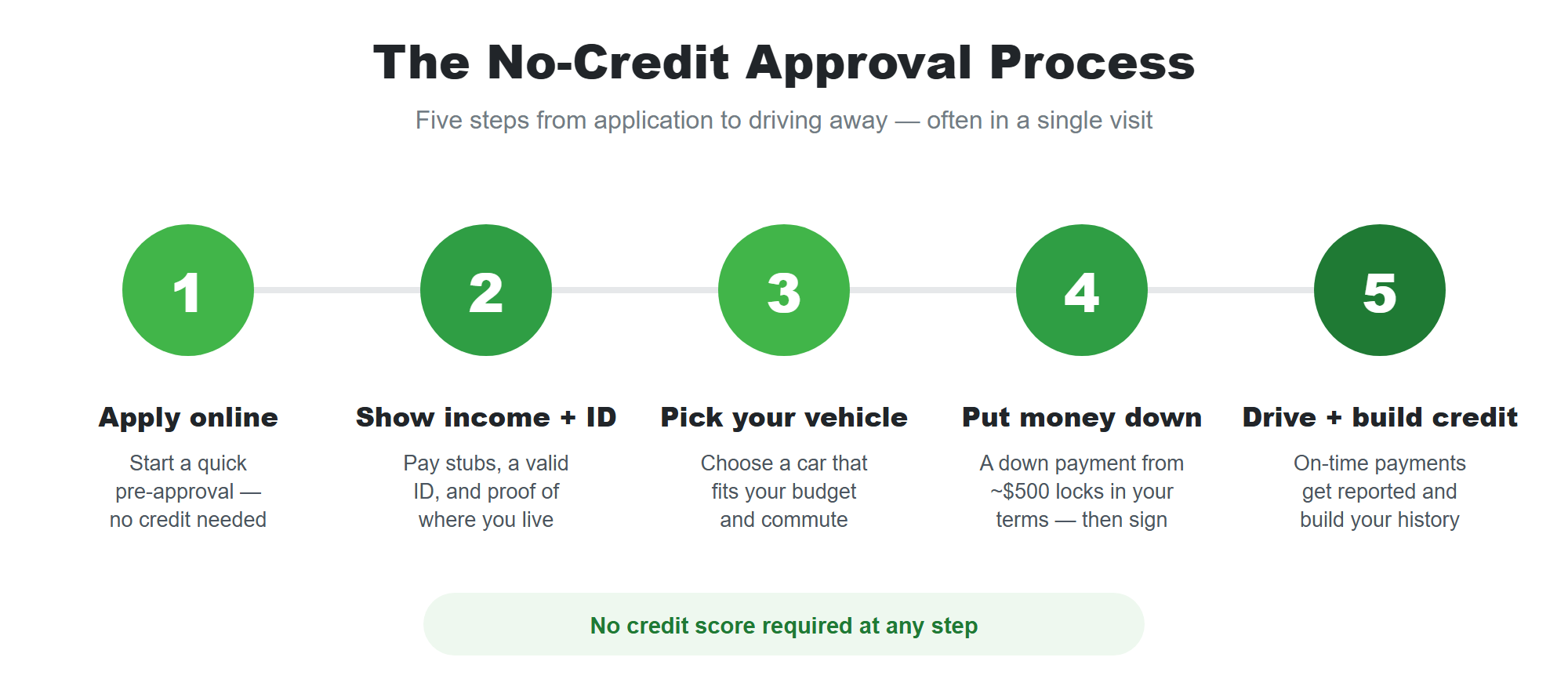
- Apply online for a pre-approval. Start with a quick form. It tells you roughly where you stand without a string of bank denials on your record. Begin with the Get Approved form.
- Verify your income and identity. Share your pay stubs, a valid ID, and proof of where you live. This is the core of a no-credit decision, so having current documents speeds everything up.
- Choose your vehicle. Pick a car that fits your budget and your commute from the available inventory. Matching the payment to what you can comfortably afford keeps you well inside what the lender will approve.
- Make your down payment and sign. A down payment, commonly starting around $500, locks in your terms. Review the rate, term, and total cost, then sign.
- Drive away and build credit. Make your payments on time, and at a dealer that reports, each one adds positive history to your file. Your first car loan becomes your first credit builder.
Real buyer scenarios
Sometimes the clearest way to see how this works is through the buyers who live it.

The recent graduate. Priya finished school in Houston, started a full-time job three months ago, and has never had a credit card. A bank had no score to read and declined. She applied at an in-house dealer with her first two pay stubs and an $800 down payment, was approved on her income and job offer letter, and drove home in a financed sedan. Her payments now report to a bureau, so the score she never had is finally starting.
The lifelong cash payer. Robert, in Oklahoma City, has always paid cash for everything, including his last two cars. At 45, he has no credit file at all. When he wanted to finance a newer truck to spread out the cost, banks treated his blank file like a risk. An in-house lender looked at his long, stable job history and steady income instead, approved him, and gave him a reason to finally build a score.
The ITIN buyer. Marisol files taxes with an ITIN and has no Social Security number, which stopped every bank she tried. She applied at a dealer that accepts an ITIN, brought proof of income and residence, put money down, and was approved the same day. She is now building credit in the U.S. for the first time, with each on-time payment.
Buying a car with no credit in Texas and Oklahoma
None of this is state-specific, but if you are in Texas or Oklahoma, here is where to start. Coast to Coast Motors runs five stores across three metros: Houston (North Freeway and Airline Drive), Oklahoma City (I-240 and Shields Boulevard), and Tulsa (Memorial Drive), each built around the first-time-buyer approach described throughout this guide.
The advantage that shows up in metros this spread out is selection. With 500+ vehicles company-wide, you can match a car to how far you actually drive instead of settling for what happens to be on one lot. You can browse the inventory online, get pre-approved before you visit, or reach out to the team with questions about financing your first car.
Ready to see what you qualify for?
A quick online pre-approval shows your likely terms in minutes, with no obligation. Bring your ID, proof of income, and proof of residence, and you can often finish at the store the same visit, even if this is the first loan of your life.
Frequently Asked Questions
Can you buy a car with no credit history?
Yes. You can finance a car with no credit history through in-house financing, where the dealership approves you on your income, job and residence stability, and down payment instead of a credit score. Bring a valid ID, proof of income, proof of residence, and a down payment, and you can often be approved in a single visit.
Is no credit better or worse than bad credit for buying a car?
No credit is usually easier to finance than bad credit. A blank file has nothing negative in it, so a lender only needs to confirm you can afford the payment. Bad credit adds a history of missed payments or a repossession that a lender has to weigh, which makes it the harder starting point.
Do I need a Social Security number to finance a car?
Not necessarily. Many dealers, including Coast to Coast Motors, accept an ITIN (Individual Taxpayer Identification Number) in place of a Social Security number. If you file taxes with an ITIN, you can often finance a car without an SSN.
How much down payment do I need with no credit?
A down payment is expected, commonly starting around $500 and rising with the vehicle's price. A larger down payment lowers your monthly payment and strengthens your application. Be cautious of any "$0 down" offer aimed at no-credit buyers, as it is usually a red flag.
Can I get approved without a co-signer if I have no credit?
Yes. Most no-credit buyers are approved through in-house financing without a co-signer, because the decision is based on your own income and stability. A co-signer can help if your income is low or your job history is very short, but it is not a requirement.
Will financing my first car help me build credit?
Yes, as long as the dealer reports your payments to a credit bureau. Payment history is the largest factor in your credit score, so on-time payments on a reported loan build positive history. Coast to Coast Motors reports to TransUnion every month, which is how a no-credit buyer's first loan becomes a credit builder.
Sources
- Consumer Financial Protection Bureau — Auto loans and getting your credit reports
- FICO — What's in your credit score (payment history = 35%)
- Experian — How to build credit from scratch
- Equifax — How to establish credit
- TransUnion — Credit score basics
- NIADA — National Independent Automobile Dealers Association