Quick Answer
Plan on 10% to 20% of the vehicle price, or roughly $1,500 to $3,000 on a $15,000 used car. Experian suggests at least 10% down on a used vehicle, versus 20% on a new one. There is no legal minimum, though. Every lender sets its own floor, and dealerships that finance in-house, like Coast to Coast Motors, commonly start buyers around $500 and size the figure to the car and the application instead of a published rule. More cash down means a smaller loan, a lower payment, less interest, and an easier yes on a borderline file. Applying is the fastest way to learn your own number, and an online pre-approval costs you nothing.
Key Takeaways
- 10% to 20% is the working target on a used car, and 10% is the common floor most guidance points to.
- No law sets a minimum. The number comes from the lender, the vehicle, and the strength of your application.
- Roughly $25 a month. That is what each extra $1,000 down removes from a five-year payment at subprime rates, along with about $500 in interest.
- Only a pre-approval gives you your number. Lenders size the down payment to the vehicle and your application, so no calculator can tell you in advance.
- Trade-in equity counts as a down payment, and in Texas it also shrinks the sales tax you owe.
- Budget past the down payment. Tax, title, registration, and your first insurance payment come due the same day.
- Documents move the number too. Verified income and a stable address often lower what a lender asks you to bring.
How much down payment do you need for a used car?
Most used-car buyers should plan on 10% to 20% of the purchase price. On a $15,000 vehicle that is $1,500 to $3,000, and on a $9,000 vehicle it is $900 to $1,800. The used-car threshold sits lower than the 20% commonly recommended for new cars for one reason: a used vehicle has already absorbed its steepest depreciation, so the loan balance and the resale value stay closer together from day one.
Real buyers land under the guideline more often than not. Edmunds reported that new-vehicle buyers averaged $5,815 down in the second quarter of 2026, which came to 11.6% of the average purchase and the smallest share since 2020. Treat 10% to 20% as the range that produces a comfortable loan, not as a bar you have to clear to buy a car.
What the money is really doing is shrinking the gap between what you owe and what the car is worth. Strip away the percentages and one question is left: can you make this payment every month for the next four or five years without rearranging the rest of your budget?
Want to know your actual down payment? Every application is different. A free online pre-approval tells you what you would need based on your income, your credit profile, and the vehicle you choose.
Is there a minimum down payment on a used car?
No law or industry rule sets a minimum down payment on a used car. Each lender draws its own line, and most draw it as a loan-to-value ceiling rather than a dollar amount. Loan-to-value compares the amount financed to what the vehicle is worth, so the "minimum" you keep hearing about is simply whatever cash it takes to bring your loan under that ceiling once tax and fees are added in.
| Where you finance | Typical minimum down | What actually sets the number |
|---|---|---|
| Bank or credit union | 0–10%, and only with strong credit | Your score and the lender's loan-to-value cap |
| Online or subprime lender | 10–20% | Risk pricing: the thinner the file, the more cash they want |
| Dealer with in-house financing | Often starts near $500 | The specific vehicle, your income, and how long you have held your job and address |
That spread is why no one can quote you a figure over the phone with any accuracy. A buyer with a 700 score putting nothing down at a credit union and a buyer bringing $700 to a buy-here-pay-here lot are both meeting a real minimum, just a different one. Coast to Coast Motors sizes its down payments application by application and starts around $500, which is why applying gives you a straight answer faster than any calculator will.
How your down payment changes the monthly payment
Every dollar you put down comes off the amount you finance, and at used-car interest rates it comes off your payment faster than most buyers expect. Here is the same $15,000 vehicle financed four different ways, over 60 months at 18% APR, which sits near the subprime average for used cars.
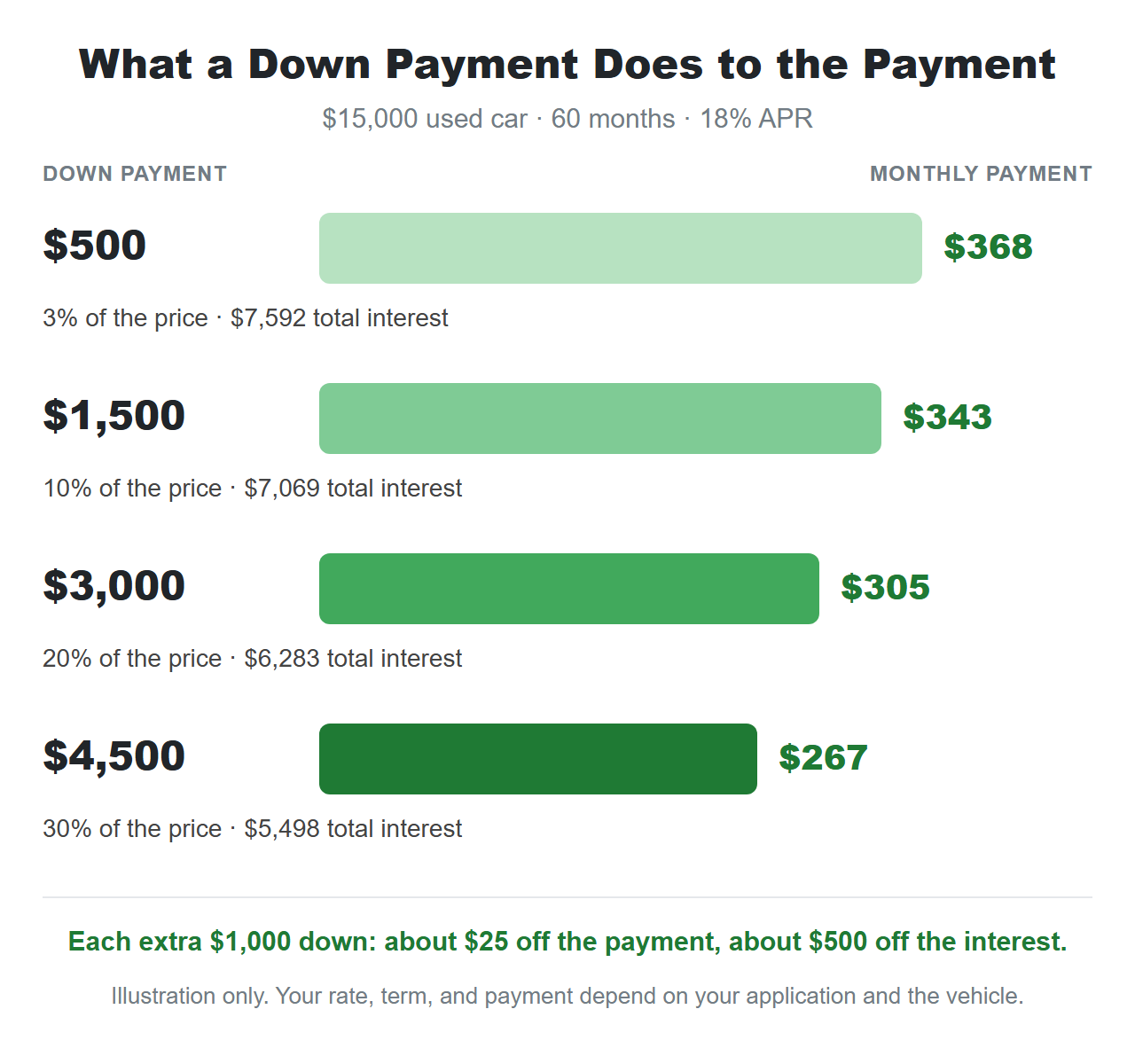
Doubling your down payment does not halve your payment, which is where a lot of buyers get discouraged. What it buys is breathing room every month, and breathing room is what keeps a loan current.
There is a second effect that rarely makes it into the math. Dropping your loan-to-value can change the terms you are offered, not just the size of the balance, because a lender pricing a loan at 85% of the car's value is taking a very different risk than one lending 120% of it. Stop short of emptying your savings to chase it, though. A car that leaves you with no cushion for the first repair bill is a more expensive car than the payment suggests.
How much should a first-time buyer plan to bring?
A first-time buyer should budget the down payment plus roughly another $1,000 for the costs that come due the same afternoon. The down payment is the number everyone quotes, but it is rarely the only money that changes hands on delivery day. Expect to cover:
- Tax, title, and registration, which are collected at the sale and calculated on the vehicle price.
- Your first insurance payment. Financed vehicles generally require full coverage, and the policy has to be active before you drive off.
- A dealer documentation fee, which varies by state and dealership.
- A small cushion for the first tank of gas, an inspection, or a set of tires that has less life left than it looked.
With no payment history to judge, a first-time application leans on income and stability, so pay stubs, a recent utility bill, and a year at the same job can matter more than the extra few hundred dollars you were planning to scrape together. If you have never financed anything before, our guide to buying a car with no credit walks through the documents that carry the most weight.

Down payments with bad credit versus no credit
Damaged credit and no credit look similar on an application, but they produce different down payment conversations. With a damaged file the lender is pricing a known risk, so the cash it asks for scales with how severe the trouble was and how recently it happened. A repossession from four months ago raises the requirement far more than a collection from four years ago, even when both files carry the same score. This is where a down payment does its heaviest work: it is the one part of the application you can still change on short notice, and bringing more of it directly offsets a record you cannot rewrite.
An empty file is a different conversation. There is nothing negative to price, so the lender is really asking whether you can carry a payment you have never carried, and documentation does most of the persuading. Our guide to buying a car with no credit covers that path in full, and what credit score you need to buy a car explains how the rest of the decision gets made. Either way the loan itself can be the fix, because Coast to Coast Motors reports payments to TransUnion every month.
Can a trade-in replace a cash down payment?
Yes. A paid-off trade-in works as a down payment, and lenders count its value the same way they count cash. What matters is equity rather than sticker value, and that distinction decides whether a trade-in helps you or quietly costs you.
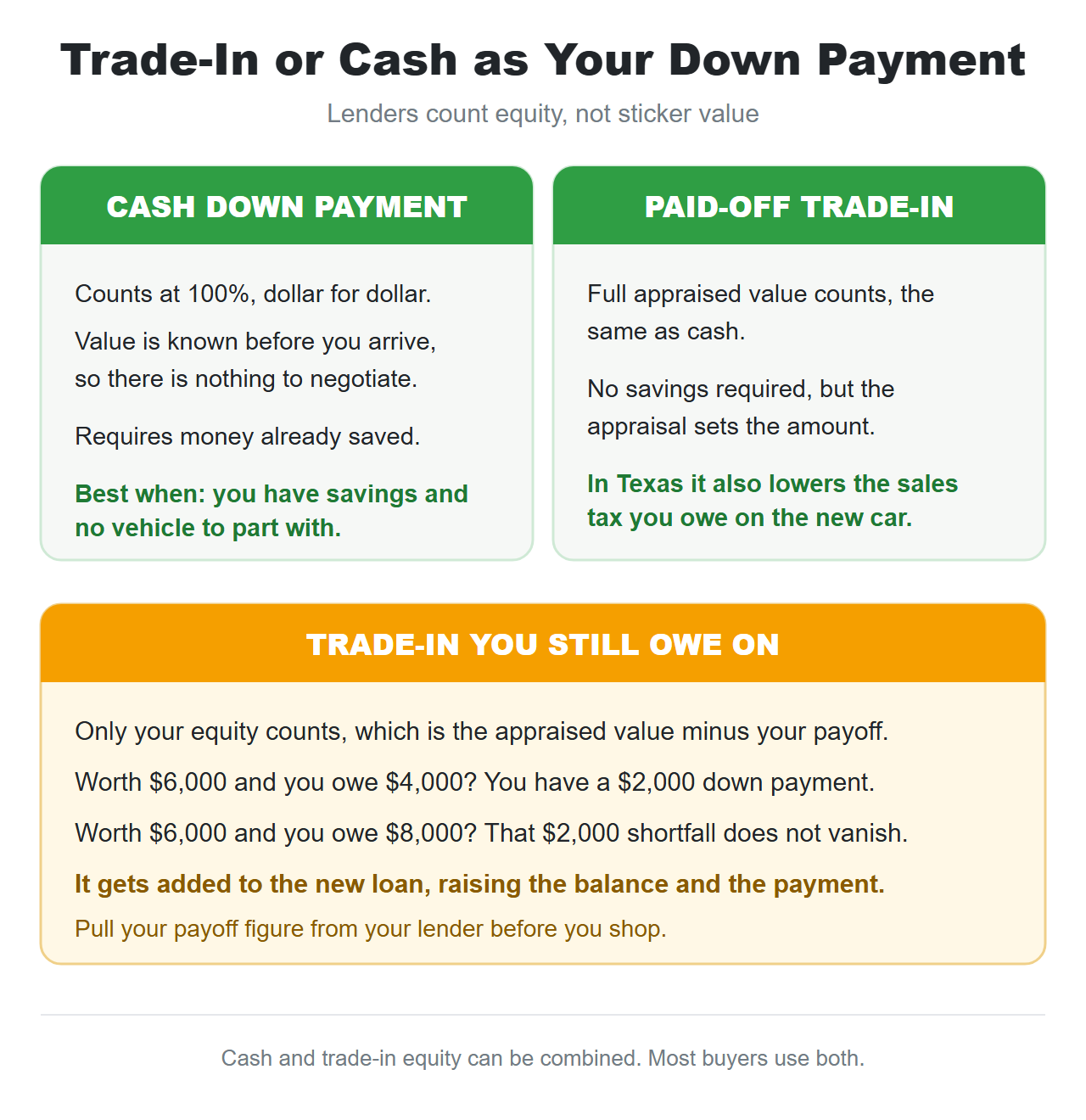
Rolling that shortfall into the new loan is the situation the Federal Trade Commission warns buyers about, and the Consumer Financial Protection Bureau has found that loans carrying negative equity come with higher balances, higher payments, and a meaningfully higher chance of ending in repossession. Get your payoff figure and a third-party valuation before you go, so you know which side of the line you are on.

There is also a tax advantage that most buyers never hear about. The Texas Comptroller allows the trade-in value to be deducted from the selling price before motor vehicle sales tax is calculated, as long as it is part of the same transaction. Trading a $3,000 vehicle against a $15,000 car means tax is figured on $12,000, saving about $188 on top of the $3,000 that came off your balance. Oklahoma treats trade-ins differently across its excise and sales taxes, so confirm the current calculation with your tag agency rather than assuming the Texas result travels.
How to lower the down payment you need
The quickest way to need less cash is to change what you are financing rather than negotiate over the figure itself. Down payment requirements are calculated from the deal, so the deal is where they move.
- ✓Shop a lower-priced vehicle. The requirement is a percentage, so it follows the price down.
- ✓Bring proof of income and residence. Verified pay stubs and a year at one address often lower the ask more than extra cash does.
- ✓Apply with a lender that finances in-house. The figure is set per application instead of by a fixed rule.
- ✓Put a paid-off trade-in toward the purchase. Its equity does the same job as cash without touching your savings.
- ✓Time it around a tax refund or bonus. A February refund funds a down payment that months of saving would not.
- ✓Add a co-signer with stronger credit. Less risk to the lender usually means less cash from you.
- ✓Ask whether it can be split across two paydays. Some in-house lenders will. Almost none advertise it.
The first three move the number most. The last one is worth saying out loud rather than assuming, because the figure you were quoted is not always fixed.
So how much should you actually put down?
Your target sits between what the lender needs to see and what you can hand over without regretting it. The path below sorts most buyers in under a minute.
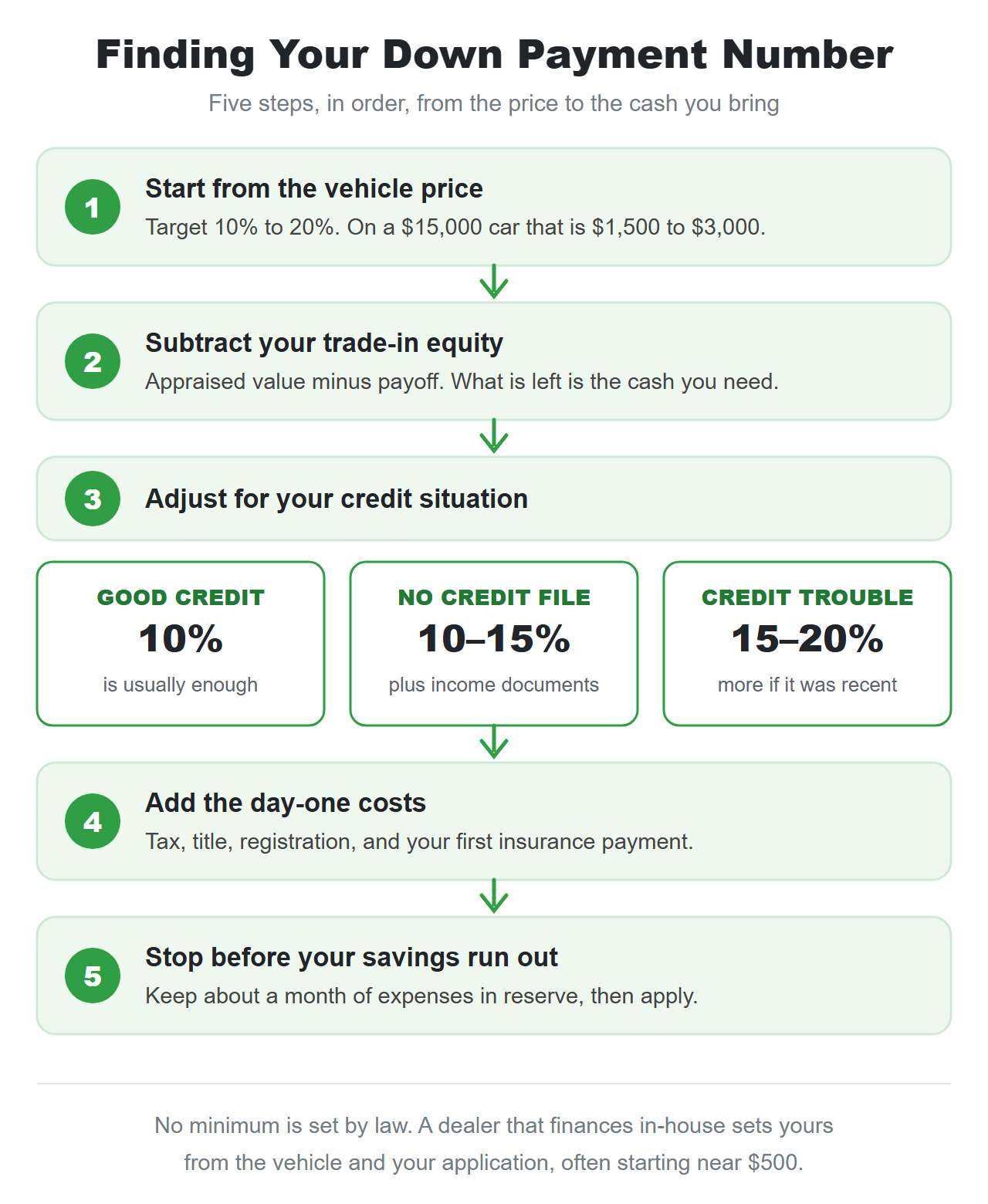
Whatever number it lands on, resist the urge to hand over everything you have. The buyers who get into trouble are rarely the ones who put down 10% instead of 20%. They are the ones who put down all of it and then met a $600 repair in month three. A payment you can absorb, with a month of expenses still in the bank, beats a heroic down payment every time.
And the honest last word: the only figure that actually applies to you comes out of an application. The vehicle, your income, and your credit history all move it, which is why two people reading this page will be quoted different numbers. Twenty minutes online will tell you yours.
Not sure what your down payment should be?
A quick online pre-approval gives you a real figure for your situation, with no obligation.
Down payment advice for Texas and Oklahoma buyers
Behind the down payment sits a simpler question: how much money do I actually need to walk in with? Here is the same $15,000 vehicle at 10% down in both states, counting everything the dealership collects on the day you sign.
| Cash needed at signing | Texas | Oklahoma |
|---|---|---|
| Vehicle price | $15,000 | $15,000 |
| Down payment (10%) | $1,500 | $1,500 |
| Vehicle tax | ≈ $938 (6.25%) | ≈ $646 (excise plus 1.25%) |
| Title | $33 | $11 |
| Registration | ≈ $85 (base plus county) | $26–$96 by vehicle age |
| First insurance payment | $150–$250 | $150–$250 |
| Plan to bring | ≈ $2,700–$2,800 | ≈ $2,350–$2,500 |
So the working figure is your down payment plus roughly $1,250 in Texas and roughly $900 in Oklahoma. Two things move it in your favour: a trade-in cuts the cash directly, and in Texas it trims the tax line as well.
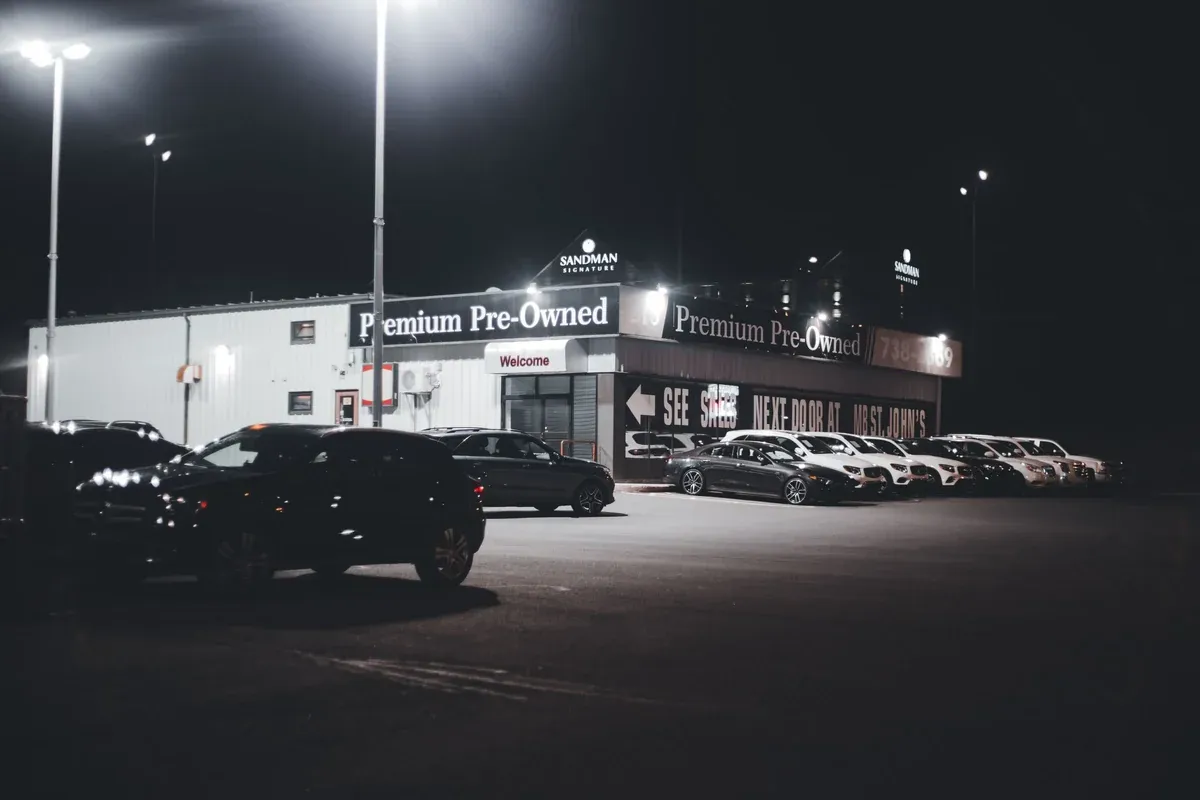
Coast to Coast Motors keeps five stores open across the two states: Airline Drive and North Freeway in Houston, I-240 and Shields Boulevard in Oklahoma City, and Memorial Drive in Tulsa. Inventory runs past 500 vehicles company-wide, so there is usually something in the price band your cash actually fits. Start with the Texas or Oklahoma listings, read how in-house financing works, compare financing options, apply for pre-approval, or call the team at any store.
Frequently Asked Questions
Can I buy a used car with $500 down?
Often, yes, at a dealership that finances in-house. Banks rarely approve that little on a used vehicle, but buy-here-pay-here lots commonly start around $500 and size the requirement to the car and your income. Expect a modestly priced vehicle and a higher payment than a larger down payment would produce.
Is 20% down required on a used car?
No. Twenty percent is a guideline aimed mainly at new cars, where depreciation is steepest in the first year. On a used vehicle, 10% is the more common recommendation, and plenty of approved loans close below it. More down always helps; none of it is required by rule.
Does a bigger down payment lower my interest rate?
Sometimes. Rate is driven mostly by your credit profile, but a larger down payment lowers the loan-to-value ratio, and some lenders price better terms when the loan sits well under the vehicle's value. Even when the rate does not move, you pay interest on a smaller balance.
Can I use my tax refund as a down payment?
Yes, and it is one of the most common down payments in the used-car market. A refund arriving in February or March lets buyers put down far more than they could save monthly. Bring the funds in a verifiable form and confirm what payment types the dealership accepts before you go.
Does a trade-in count as a down payment if I still owe money on it?
Only the equity counts. If the trade is worth more than your payoff, the difference works exactly like cash. If you owe more than it is worth, the shortfall is typically added to your new loan, which raises the balance and the payment. Get your payoff figure before you shop.
Do I still pay tax, title, and registration on top of the down payment?
Yes. Those are separate from the down payment and are collected at the sale. On a $15,000 used car, plan for roughly $1,250 in Texas and roughly $900 in Oklahoma on top of your down payment, with your first insurance payment included.
Will a larger down payment get me approved with bad credit?
Usually, and it is the fastest change you can make before applying. Lenders scale the cash they want to how severe and how recent your credit trouble was, so more money down offsets a weak file directly. Documented income and a steady address help the same application further.
Should I put down more than 20% on a used car?
Only if it still leaves you a cushion. Going past 20% keeps cutting your payment and interest, but a down payment that empties your savings puts the first repair bill on a credit card. Keep about a month of expenses in reserve, then put the rest toward the car.
Sources
- Experian — How much of a down payment should you make on a car? (at least 10% used, 20% new) and Average car payment in 2026 (Q1 2026 used-car averages: $27,070 financed, $531 payment, 11.43% APR, 67.7-month term)
- Edmunds — Industry press releases (Q2 2026 average new-vehicle down payment of $5,815, or 11.6% of purchase price; used-vehicle amount financed of $30,414)
- Bankrate — Average car payments in 2026 (used-car APR by credit tier)
- Consumer Financial Protection Bureau — Negative equity findings from the auto finance data pilot and Auto loans
- Federal Trade Commission — Auto trade-ins and negative equity and Financing or leasing a car
- Texas Comptroller of Public Accounts — Motor Vehicle Tax Guide: tax rates (6.25%) and trade-ins
- Texas Department of Motor Vehicles — Vehicle title and registration fees
- Service Oklahoma — Motor vehicle fees and excise tax ($20 on the first $1,500 plus 3.25%, and 1.25% vehicle sales tax)