
Quick Answer
Yes — a repossession does not automatically rule out financing another vehicle. No federal law and no credit bureau rule sets a waiting period, so each lender decides for itself, and some work specifically with applicants whose credit includes past problems. What usually carries the most weight is your position today: verifiable income, steady employment and address history, a payment that fits your budget, and how the old balance was resolved. Coast to Coast Motors names previous repossessions among the situations its loan specialists work with. Applying is the only way to see what is available to you.
Can you get another car loan after a repossession?
Yes, and whether you do comes down to the individual lender rather than to the repossession itself. It lowers your score and it tells the next lender that a secured loan ended badly. What it does not do is override everything else in the file.
Lenders differ on this more than on almost anything else. A bank working to a fixed score floor may decline before a person reads the application; a dealership that finances its own sales weighs a different set of facts, because it carries the loan itself. The same applicant can genuinely hear no in one place and yes in another the same week.
Coast to Coast Motors addresses this on its financing page, where previous repossessions sit alongside foreclosures, bankruptcies, charged-off accounts and judgments as “obstacles that we have overcome in the past.” It adds that “each person’s situation is a little different,” the honest qualifier: working with repossessions routinely is not the same as approving everyone.
What happens to your credit after a repossession?
A repossession is reported for seven years, and the clock starts on the first payment you missed and never made up, not on the day the car was taken. Those two dates are usually months apart, and the earlier one is the one that counts.
Experian sets out the arithmetic plainly. Miss your first payment in July 2026, lose the vehicle that November, and the repossession appears on your report in November but drops off in July 2033. The older date is the one that decides when it goes.
That cap comes from the Fair Credit Reporting Act, which limits how long adverse information may be reported and says nothing about when you may borrow again. One more thing to check: if the leftover balance went to a collection agency, a second account can appear beside the original loan. It comes off seven years after that same original delinquency date, not when the collector received it, so one dated from the handover is reporting too long.
The damage also fades. Experian notes the impact diminishes over time, particularly once newer positive information sits in the file against it.
How soon can you finance another car after a repossession?
There is no universal waiting period. No law, no credit bureau rule and no industry standard sets a number of months you have to sit out. Any figure you see quoted is one lender’s policy described as a rule.
What does change with time is the evidence you can put in front of someone. Six months of on-time payments on anything that reports, six months at one employer, a settled balance, an address that has not moved: none existed the week the car went. Time alone does little. Time plus a record moves an application.
The clock has also run longer than you think: because reporting starts at that first missed payment, a repossession from last year may already be two years into its seven. Some buyers are approved within months, others do better after a few months of preparation, and the difference is rarely the calendar. It is whether the file answers the question a lender is actually asking, which is not what happened then but whether this payment gets made now.
What do lenders look at after a repossession?
Most of what a lender reviews describes your situation today, not the loan that ended. The repossession is one line. Your application is the rest of the page.
Verifiable income comes first, because a payment has to come from somewhere someone else can confirm. Then how long it has held steady, since two years with one employer reads differently from four jobs in eighteen months. Then where you live and for how long, and what you already owe each month, which decides whether another payment fits. Then the vehicle, because the amount financed against its value is the lender’s risk as much as yours.
Here is the part that gets missed: underwriters read the order of events, not just the list. A repossession followed by two years of accounts paid on time tells a different story from one followed by three new collections. Alone in an otherwise current file, it reads as a single disruption rather than a habit. You cannot remove the mark, but you do control what comes after it.
Your score still matters, mostly as a starting point. Our guide to what credit score you need to buy a car covers how the number is read alongside the rest.
Does an unpaid repossession balance affect your next car loan?
It can, but on its own it is rarely the reason for a decline. That balance has a name: the deficiency. When a repossessed car sells for less than was owed, the difference plus repossession costs stays with you.
The CFPB’s example is the clearest: owe $10,000, the lender sells the car for $7,500, and you owe the $2,500 difference plus fees. Its January 2025 research put the average balance still outstanding above $11,000 as of December 2022.

For the next lender this is a live obligation, counted against what you can afford each month while it is being collected. Settling it does not erase the repossession, which stays its seven years either way. What changes is that the file shows a debt resolved rather than one running.
So find out where it stands before you apply anywhere. Call whoever holds the debt, ask for the current figure in writing, and ask whether a settlement is possible. Plenty of buyers are financed with a deficiency still open. Far fewer are helped by not knowing the number when someone asks.
Voluntary vs. involuntary repossession
Handing the keys back yourself is not the clean exit it is often described as. The FTC is direct: a voluntary repossession might cost you less in fees, but you still owe the difference between the contract balance and what the car sells for, and the creditor still may report the late payments or the repossession.
On the credit file the two look much alike. Experian’s position is that the damage is broadly equivalent, though some lenders view a voluntary surrender slightly more favorably because it shows a borrower willing to work with them. That is a judgment a person makes, not a scoring difference you can count on.
Where the difference is real is the arithmetic. Fewer recovery and storage fees mean a smaller deficiency, which is less to settle before the next application. It does not shorten the seven years, and it does not keep the event off your report.
Where your repossession stands, and what to bring
The practical difference between one repossession and another comes down to two questions: how long ago, and is anything still owed? The rows overlap, so most people match more than one. Use it to find the document you are missing.
| Your situation | What it means for a new application | What to bring |
|---|---|---|
| Repossession within the last 12 months | The newest entry in your file, so expect it to come up. Current income and stability carry the weight. | Proof of income for the months since, plus a document showing your current address. |
| Repossession two or more years ago | Already aging, and further from the delinquency date the seven years run from. | Whatever you have paid on time since. |
| Deficiency paid or settled | The account reads as resolved, with no active collection competing for your income. | The payoff or settlement letter, in writing. |
| Deficiency still outstanding | Reduces the monthly room a lender has to lend into. Rarely a decline on its own. | The current balance in writing, and who holds the debt. |
| Voluntary surrender | Reported much like an involuntary repossession, usually with a smaller balance behind it. | The final statement showing what was owed after the sale. |
How to strengthen your application after a repossession
The strongest thing you can do is arrive with the facts already in hand. None of the steps below needs an approval or a fee.
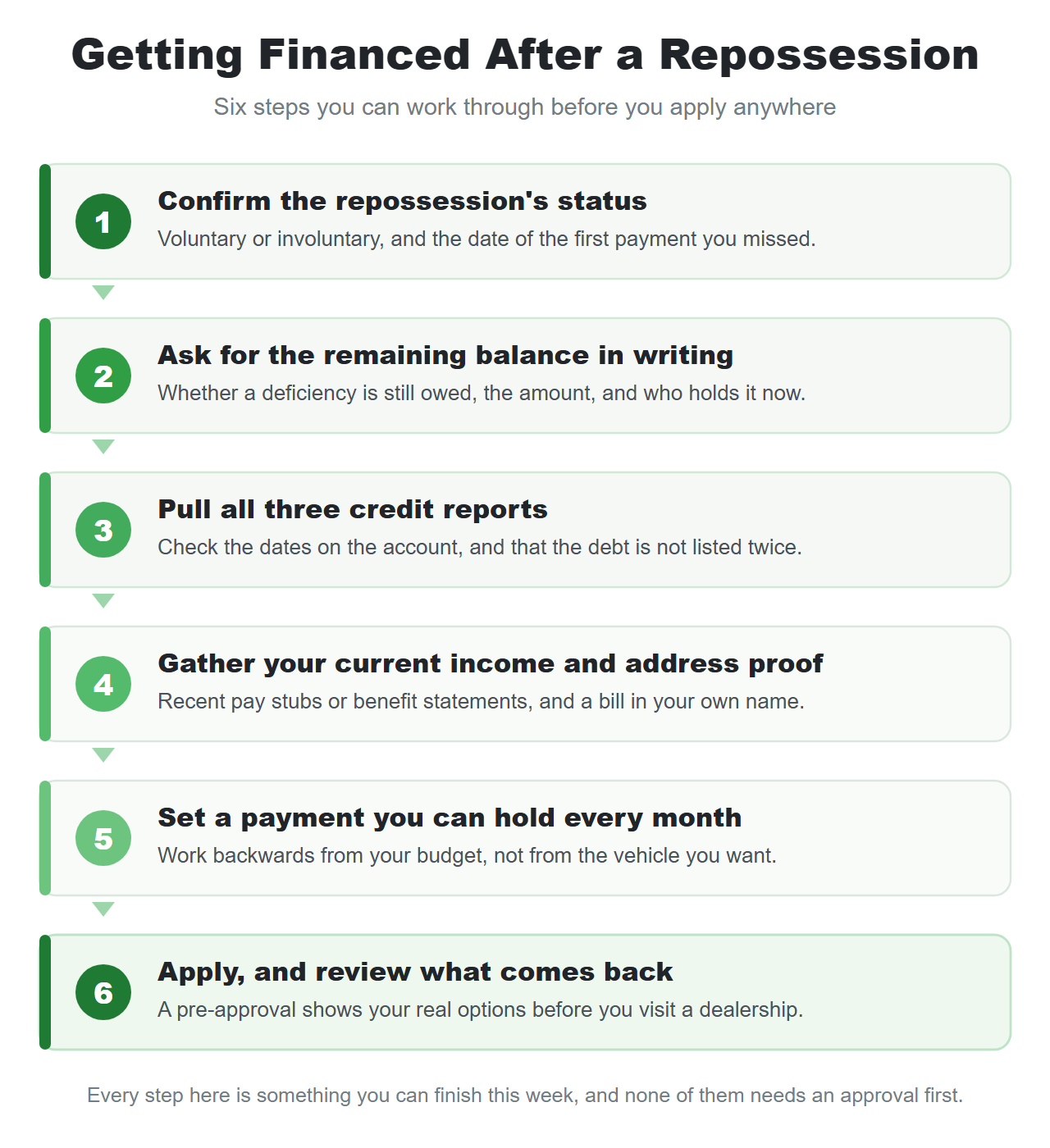
The order is the part worth keeping. Steps one to three tell you what a lender will see before they see it, which is what prevents a surprise at the desk; four and five are what you set against it. The step people skip is the fifth. Working backwards from a payment you can hold every month, rather than forwards from the car you have been picturing, is the largest thing under your control. If credit is the wider worry, our guides to buying a car with bad credit in Texas and buying with no credit at all cover that ground.
Not sure what your file will support? A free online pre-approval puts a real payment and down payment figure against your situation, so you shop with a number rather than a hope.
Buying a car after a repossession at Coast to Coast Motors
Coast to Coast Motors finances its own sales, so a file with a repossession in it is read by the people making the decision. Its financing page describes the sequence: a one-page application, verification by the finance department, then the loan amount back, generally inside an hour.
Two details matter if you are rebuilding. Down payments are not preset per vehicle; the store says your information is evaluated individually rather than matched to a windshield figure, so the number comes out of your application. A down payment is still required. And payment history is reported monthly to TransUnion, including the positive months, so the next loan can rebuild the file the last one damaged.
Across five stores in Houston, Oklahoma City and Tulsa, browse the inventory and find the closest location. The dealership’s explainer on buy here pay here versus traditional financing covers how it differs from a bank loan.
The bottom line: a repossession changes what your credit file says about you. It does not decide what you can do next. The seven years are already running, and they started earlier than you think. Today’s income, address and budget are the parts you can still shape, and where a lender looks hardest. Find out what is still owed, get your paperwork together, put a payment you can hold on paper, and apply.

Ready to find out where you stand? Apply online to see your financing options at Coast to Coast Motors before you visit.
Frequently Asked Questions
Can I get a car loan after a repossession?
Often, yes. It hurts your score and stays on file for seven years, but it is one entry among many, and lenders set their own rules about how much it counts. Coast to Coast Motors names it on its financing page as one of the credit problems it has worked around before.
How soon can I buy another car after a repossession?
There is no required wait anywhere in law or in credit reporting rules, so the timing is the lender's call rather than a countdown. Approvals do happen within months of a repo. What moves the needle is a run of payments made on time, income that can be checked, and a realistic vehicle.
How long does a repossession stay on my credit report?
Seven years. The countdown begins with your earliest unpaid missed payment, not the day the vehicle disappeared, and those can sit half a year apart. Any collection account raised for the shortfall drops off on that same anniversary.
Does a voluntary repossession make it easier to finance again?
Barely. Per the FTC, handing the car back on your own terms can trim the recovery charges, but the shortfall remains your debt and the creditor is still free to report what happened. Neither the seven-year window nor the entry itself changes.
Do I have to pay off a repossession before I can finance another car?
Usually not. An unresolved shortfall does eat into your monthly capacity and lenders weigh that, but people are approved with one open. Clearing it will not wipe the repossession off your file either. Ask for the amount on paper before you apply, so nothing surprises you at the desk.
Will I need a bigger down payment after a repossession?
Lenders differ. Putting more cash in shrinks the sum being financed and with it the risk, which can work in your favor. Coast to Coast Motors sets no fixed figure per vehicle, so yours follows from your application. Some down payment is always needed.
Can in-house financing help after a repossession?
Sometimes. Where the seller is also the lender, nobody forwards your file elsewhere for a verdict, and the review tends to lean on what you earn and how settled you are now. It is one option among several, and nothing is decided before you apply.
Sources
- Coast to Coast Motors — In-House Financing Program FAQs (previous repossessions, foreclosures, bankruptcies, charged-off accounts, tax liens and judgments described as “obstacles that we have overcome in the past”; monthly payment history reported to TransUnion; no pre-set down payments per vehicle; approval process generally finished in under an hour) and Get Approved
- Consumer Financial Protection Bureau — What happens if my car is repossessed? (the deficiency after sale, the $10,000 loan / $7,500 sale example, repossession fees, and the up-to-seven-years credit reporting window)
- Consumer Financial Protection Bureau — Repossession in Auto Finance, January 2025 (average outstanding balance after repossession above $10,000 in December 2019 and above $11,000 in December 2022; data from nine auto lenders)
- Federal Trade Commission — Vehicle Repossession (a voluntary repossession may cost less in fees, but the borrower still owes the difference after sale and the creditor still may report the late payments or the repossession)
- Experian — How Long Does a Repossession Stay on Your Credit Report? (seven years from the original delinquency date, not the repossession date; a collection for the deficiency is removed seven years after that same original date; voluntary surrender carries comparable damage)
- Experian — How to Fix Credit After a Car Repossession (the negative impact diminishes over time, particularly when newer positive information is added to the file)
- Fair Credit Reporting Act — 15 U.S.C. § 1681c (the statutory limit on how long adverse information may be reported; it governs reporting, not lending decisions)