There's a piece of this that most Oklahoma buyers are never told: a low score is one of the most ordinary situations on the road right now, and there is a well-worn, dependable way to finance a vehicle in spite of it. This guide is written for Oklahoma drivers — shoppers in Oklahoma City and Tulsa especially — and it lays out how the process actually runs in 2026: what a lender means by "bad credit," whether a score in the 500s can still be approved, how much cash you'll want up front, what a used car really costs in Oklahoma once excise tax and fees land, and the moves that lift your odds before you ever submit an application.
Quick Answer
You can buy a car with bad credit in Oklahoma by applying at a dealership that finances in-house rather than sending you to a bank. These dealers base the approval on your current income, how steady your job is, and your down payment instead of your credit score, so buyers in the 500s — and people with no credit file at all — can still qualify. Plan to bring a valid ID, proof of income, proof of where you live, and a down payment that commonly starts around $500, plus Oklahoma excise tax, the 1.25% vehicle sales tax, and tag fees on top of the price. At an Oklahoma dealer that reports to a credit bureau, like Coast to Coast Motors (which reports monthly to TransUnion), every on-time payment also rebuilds your credit. You can get pre-approved online before you set foot on a lot.
What is considered bad credit when buying a car?
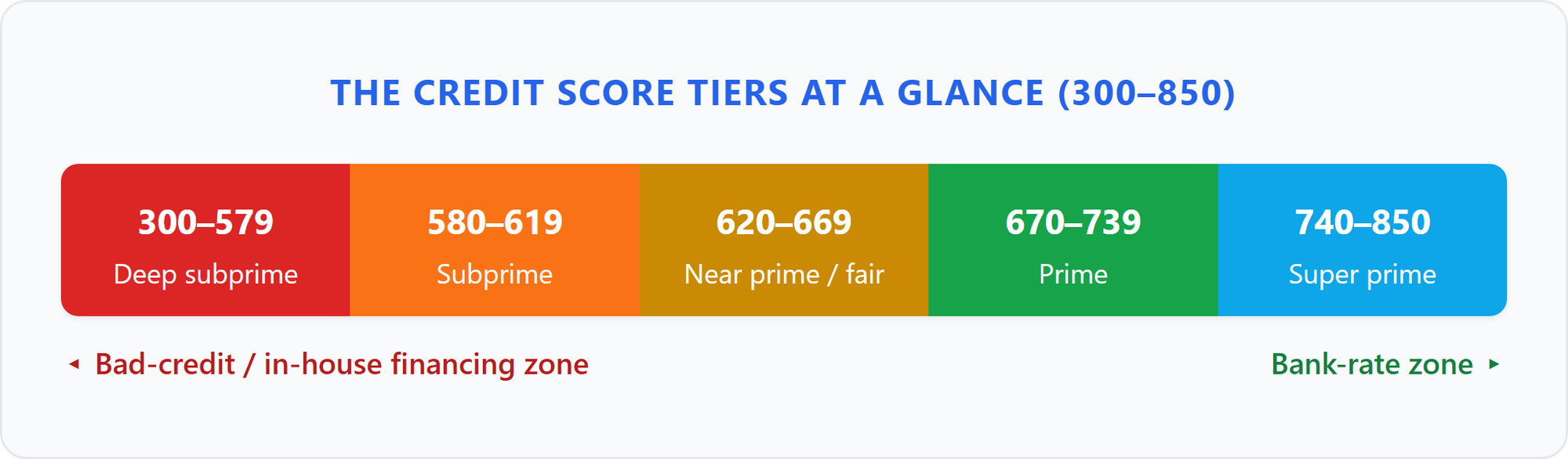
Bad credit usually means a FICO score under 580, while the 580-to-669 band gets labeled "fair" or subprime by most auto lenders. No single rule draws the line, but the tiers below are the ones Oklahoma lenders lean on when they price a loan.
Scores run from 300 to 850. FICO and Equifax sort them into tiers, and auto lenders set rates tier by tier. Experian puts "subprime" at roughly 580–619 and "deep subprime" below 580 — precisely where bank approvals dry up and in-house financing turns into the realistic path.
| Credit tier | FICO score range | What it usually means for an auto loan |
|---|---|---|
| Deep subprime | 300–579 | Most banks deny; in-house financing is the practical path |
| Subprime | 580–619 | Approvable but high bank rates; in-house often easier |
| Near prime / fair | 620–669 | May qualify at a bank, usually at a higher rate |
| Prime | 670–739 | Qualifies for standard bank rates |
| Super prime | 740–850 | Qualifies for the lowest available rates |
If your score sits in one of the lower tiers, you've got plenty of company. About 1 in 5 American adults carries a score of 620 or below, per 2025 Bankrate analysis, and subprime borrowers accounted for 22.47% of all used-vehicle financing in Q4 2025, according to Experian's State of the Automotive Finance Market — the biggest fourth-quarter share since 2021. A damaged score isn't some rare exception in Oklahoma. It describes close to a quarter of everyone financing a used car.
Can you buy a car with a 500 credit score in Oklahoma?
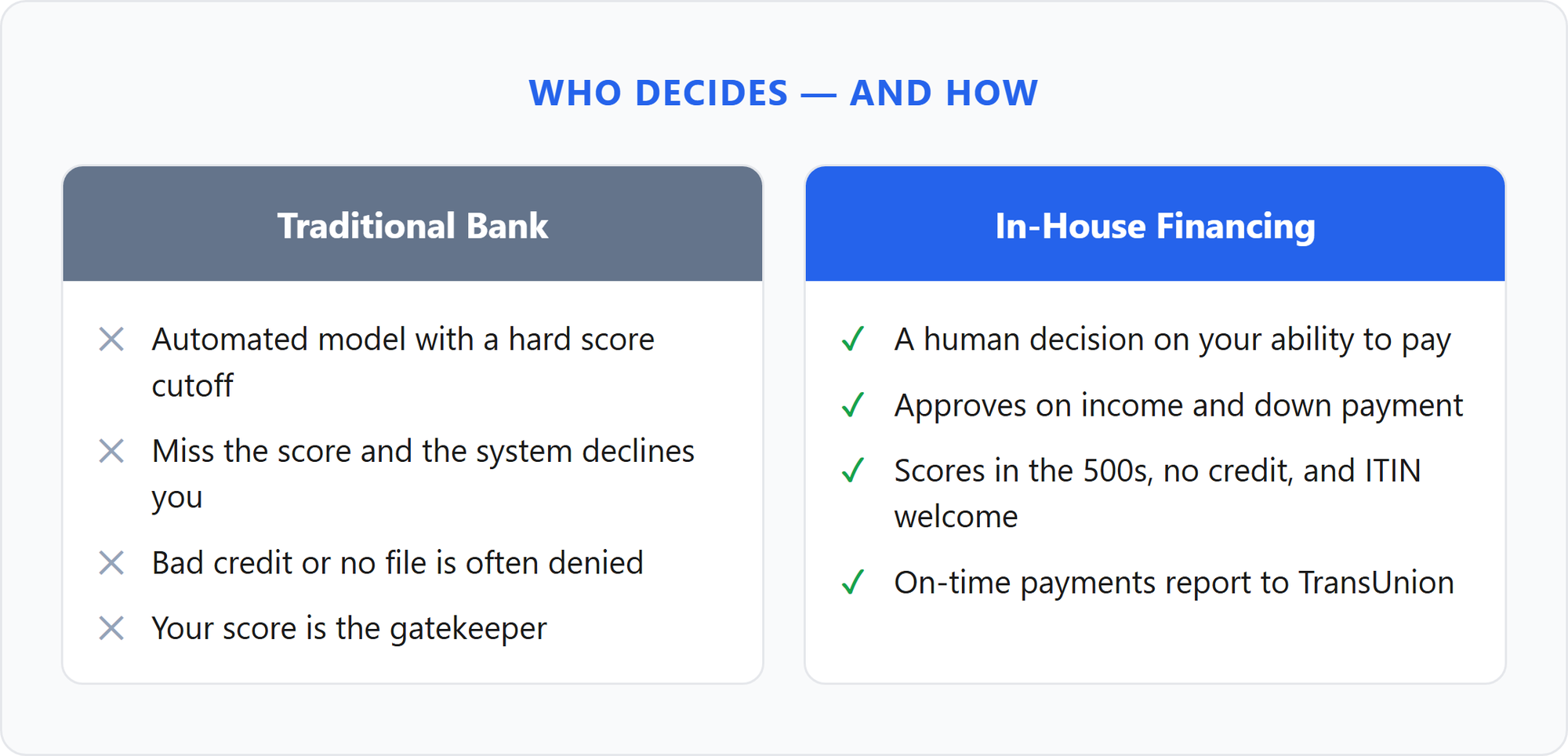
Yes — and it happens all the time. A 500 falls into deep subprime, the tier where most banks and credit unions hit "decline" on reflex. Oklahoma dealerships that carry their own paper, though, sign off on buyers at this level day in and day out, because they're not measuring you against that one rigid cutoff.
The deciding factor is who's actually making the call. A bank runs your file through a model with a fixed score threshold: come in under it and the answer is no, no matter how reliable your paycheck. An in-house dealer looks instead at what you can shoulder right now — your income, how long you've held the job, and the money you bring to the table. Inside that picture, a 500, a 520, or a 540 is one number among several, not a sealed door.
It's the approach we break down in our guide to how in-house financing works at used car dealerships: the dealer is the lender, so it writes its own approval rules. Coast to Coast Motors focuses on arranging financing for buyers who've hit credit trouble and says it can work with nearly any credit situation. For a 500-score buyer anywhere from Oklahoma City to Tulsa, the practical move is to stop collecting bank denials and apply where a low score is the norm rather than a disqualifier. You can start an online pre-approval and see your terms before you drive over.
Real-world example: Brandon, a line cook in south Oklahoma City, was sitting at a 511 after a charged-off card and a car that got repossessed two years back. A bank and a credit union both said no. He walked into an Oklahoma City buy-here-pay-here lot with a month of pay stubs and a $750 down payment, got approved that same afternoon, and drove off in a financed SUV — with those payments now posting to a credit bureau and rebuilding the very score that had sunk his bank application.
Can you get approved with no credit?
Yes. An empty credit file is a different animal from a damaged one, and it's often the easier case to sort out. Since in-house financing is built around what you can pay today, having little or nothing on record simply doesn't stand in the way.
A bank's underwriting needs a score to size up risk, so when there's no file to pull, it usually retreats to "no." An in-house dealer isn't cornered the same way. First-time buyers, drivers fresh out of school, families who recently moved to Oklahoma, and people who've paid cash their whole lives can all win approval on steady income and a sensible down payment.
This carries real weight across Oklahoma City and Tulsa. Buyers without a Social Security number can frequently finance with an ITIN (Individual Taxpayer Identification Number) at lenders set up to accept one — Coast to Coast Motors takes an ITIN in place of an SSN, which opens the door for many first-time buyers in Oklahoma's growing Spanish-speaking communities, where the team also helps customers in their own language. Always confirm ITIN acceptance with a dealer before applying, then browse the Oklahoma inventory to find a vehicle in your range.
What documents do you need?
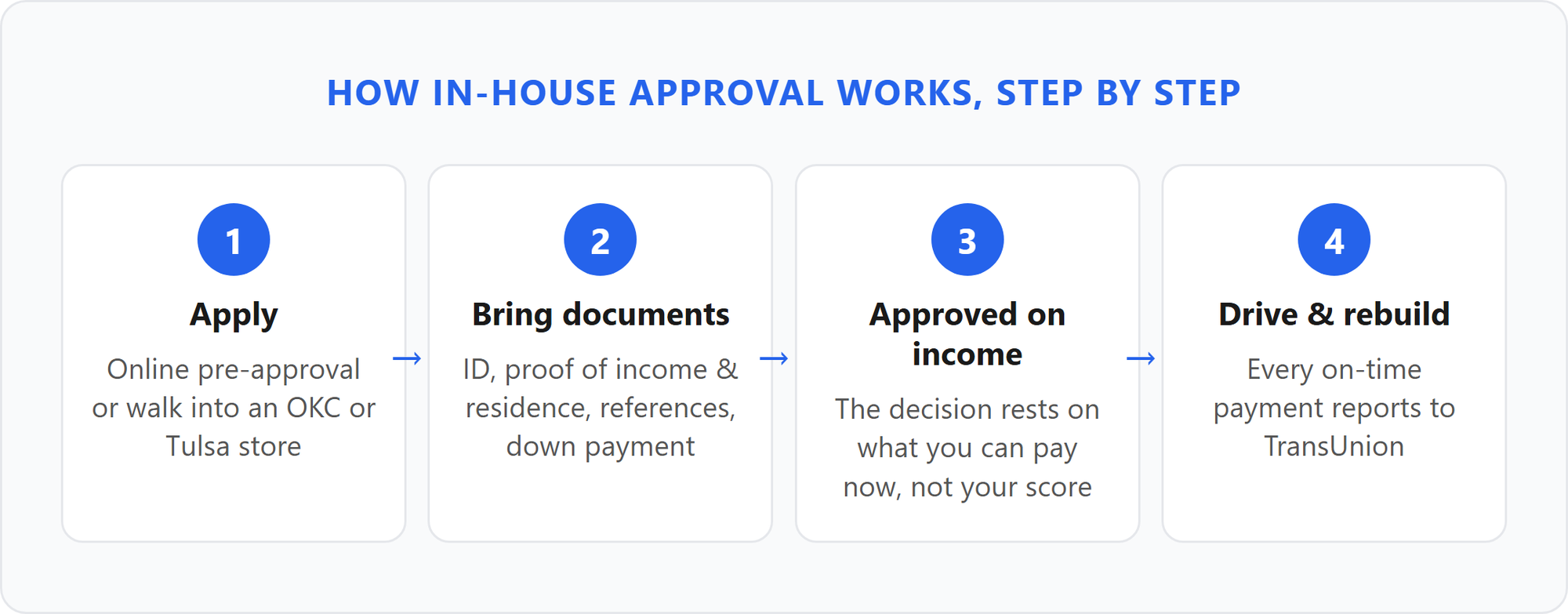
Expect a shorter paperwork list than a bank would hand you. Because in-house financing mainly wants proof you can keep up with the payments, the checklist stays lean — it's built on income and where you live, not a deep financial history.
Bring these when you apply:
- Valid government-issued ID — an Oklahoma driver's license, state ID, or passport
- Proof of income — recent pay stubs, or bank statements / 1099s if you're self-employed
- Proof of residence — an Oklahoma utility bill, lease, or mortgage statement in your name
- Proof of a working phone number — sometimes a recent phone bill
- A down payment — cash, debit, or a trade-in
- References — a few personal references with phone numbers
- ITIN or SSN — an ITIN stands in for a Social Security number at dealers that accept it
What speeds an approval more than anything is showing up with these current and in hand. The Consumer Financial Protection Bureau suggests pulling together your income and residence paperwork before you shop, since it lets the lender verify you fast and lets you weigh real terms instead of rough guesses. Arrive at an Oklahoma lot with clean documents and you can often wrap the whole thing up in one trip.
How much down payment should you expect?
Count on putting money down. For bad-credit buyers the figure tends to open around $500 and rises with the price of the car and the rest of your profile. The more you put down, the less you finance — which shrinks the monthly payment and tends to unlock better terms and a wider field of vehicles to choose from.
Every credible subprime lender asks for a down payment for the same reason: it lowers risk on both sides and hands you equity in the car from day one. Read "$0 down" or "no money down" subprime ads as a caution flag — a legitimate lender will want a fair amount up front. Coast to Coast Motors does require a down payment, but keeps the options flexible and the entry point low so the upfront cost stays reachable.
Here's how the down payment reshapes a typical $12,000 financed purchase:
| Down payment | Amount financed | Effect on your loan |
|---|---|---|
| $500 (minimum) | $11,500 | Lowest upfront cost; higher monthly payment |
| $1,500 | $10,500 | Noticeably lower monthly payment; better terms likely |
| $2,500+ | $9,500 or less | Smallest payments; widest vehicle selection; lowest total cost |
A trade-in can go toward your down payment too. The working rule: put down as much as you can without emptying your emergency savings. The average used-car loan now sits at roughly $537 a month on about $27,500 financed over a 67-month term (Experian, Q4 2025), so anything you do up front to cut the balance keeps paying off across the life of the loan. You can weigh real vehicles and prices in the Oklahoma inventory before settling on how much to bring.
What a bad-credit used car really costs in Oklahoma
The sticker is only one slice of what you'll actually pay in Oklahoma. Before you lock in a budget, build in the state taxes and fees that hit at the time of sale — they blindside a lot of first-time buyers, and they apply whether your credit is spotless or you're financing in-house.
Oklahoma charges a 3.25% motor-vehicle excise tax — figured as $20 on the first $1,500 of the price and 3.25% on the rest — plus a separate 1.25% vehicle sales tax, for a combined bite near 4.5%, according to Service Oklahoma. On a $12,000 used car that's roughly $510 in tax, on top of an $11 title fee and an annual registration (tag) fee scaled to the vehicle's age. It's lighter than the vehicle tax in a number of nearby states, but it's still real money to plan around.
| Cost | What to expect in Oklahoma |
|---|---|
| Vehicle price | Most bad-credit used inventory runs roughly $8,000–$18,000 |
| Down payment | Commonly starts around $500; a trade-in can count toward it |
| Excise + sales tax | 3.25% excise + 1.25% sales tax (~4.5% combined) — Service Oklahoma |
| Title & registration | $11 title fee plus an annual tag fee set by the vehicle's age |
| Monthly payment | Set by the price, your down payment, the term, and the rate |
| Insurance | Required to finance and drive in Oklahoma |
The figure that matters most on a financed car isn't the monthly payment — it's the total cost over the life of the loan, the price plus interest, tax, title, and fees combined. A small monthly number can disguise a long term and a steep rate, so always ask for the total you'll pay and the APR. The financing program at Coast to Coast Motors is built around payments a working budget can genuinely carry, with the credit-rebuilding reporting baked in.
How to improve your approval odds
You can tip a bad-credit approval in your favor far more than most buyers expect. Most of the levers are things you can move in the weeks before you apply, and stacked together they can turn a shaky file into a confident yes.
- Check your own credit first. You're entitled to free reports from the major bureaus, and errors show up often. Disputing a wrong collection or balance can nudge your score up before you apply. The CFPB walks through how to pull and dispute them.
- Save the biggest down payment you reasonably can. For a subprime buyer this is the single most powerful lever — it directly reduces the lender's risk.
- Gather proof of steady income. Time on the job carries as much weight as the dollar amount. Two recent pay stubs from the same employer say a lot.
- Have your documents ready. ID, income, residence, and references in hand show you're prepared and let the dealer approve you faster.
- Consider a co-signer or co-buyer. A second applicant with stronger credit can shore up a thin file, though in-house financing doesn't require one.
- Set a realistic budget before you shop. Knowing your monthly ceiling — Oklahoma excise tax, sales tax, and tag fees included — keeps you inside the range a lender will comfortably approve.
- Apply where bad credit is expected. Pre-applying online at an in-house lender shows you real terms without stacking bank denials onto your file. Start with the Get Approved form.
Common mistakes buyers make
Nearly every snag buyers hit on a bad-credit purchase is avoidable. It usually comes from rushing the deal or locking onto the wrong number. Watch for these:
- Shopping by the monthly payment alone. A low monthly figure can hide a long term and a high total cost. Ask for the total you'll pay and the interest rate (APR), not just the payment.
- Applying at a dozen banks first. A pile of hard inquiries can chip away at an already-low score, and the denials get you no closer to a car. Apply where your credit tier is the expected customer.
- Not asking whether the dealer reports to a credit bureau. This separates a loan that rebuilds your credit from one that does nothing for it. Ask before you sign.
- Trusting a "$0 down" subprime offer. It usually points to a thin deal, buried costs, or a vehicle that won't last. Expect a reasonable down payment from any legitimate lender.
- Forgetting Oklahoma tax, title, and tag fees. The 3.25% excise tax, the 1.25% sales tax, and registration are due at the sale — budget for them so they don't swallow your down payment.
- Skipping the vehicle inspection. You're buying a used car. Test drive it, and spring for an independent inspection on the pricier ones.
- Stretching the budget too thin. A repossession damages your credit worse than where you started. Pick a payment you can make in a bad month, not just a good one.
Buying a car with bad credit in Oklahoma City, OK
Oklahoma City sprawls across one of the widest, lowest-density metros in the country, so the car you pick has to fit how far you really drive each day. For bad-credit buyers that puts selection on equal footing with approval — you want a genuine range of dependable vehicles, not whatever happens to be left on a corner lot. The workable route here is an in-house lender that approves on income instead of a bank's score cutoff, and OKC gives you real options for it.
Coast to Coast Motors covers Oklahoma City with two stores: the I-240 location at 801 W I-240 Service Rd and the Shields Boulevard location at 4816 S Shields Blvd. Both work with almost any credit situation, accept an ITIN in place of an SSN, and report your payments to TransUnion every month — so an OKC buyer with a banged-up file can drive a reliable car now and rebuild credit while paying it off. Between them the two stores hold a Google rating near 4.6–4.7 across thousands of reviews, and they're backed by an Oklahoma inventory of more than 500 vehicles you can view online. The team also serves Oklahoma City's Spanish-speaking community in their own language. Our roundup of the best buy-here-pay-here dealerships in Oklahoma City shows how the local lots stack up.
Real-world example: Danielle, a hospital aide on the south side of OKC, had no credit history at all after years of paying cash for everything. A bank had nothing to score her on and declined. She applied with two pay stubs and a $700 down payment, was approved on her income and job stability, and is now building a credit file for the first time with every on-time payment. You can get pre-approved online before visiting either OKC store.
Buying a car with bad credit in Tulsa, OK
Plenty of Tulsa buyers land at Coast to Coast Motors' Memorial Drive store after hearing "no" somewhere else — a bank, a credit union, or a dealer that only finances clean credit. A past repossession, a thin file, or an old bankruptcy doesn't shut down the conversation here; approval hinges on what you can pay now, not what your score looked like three years ago.
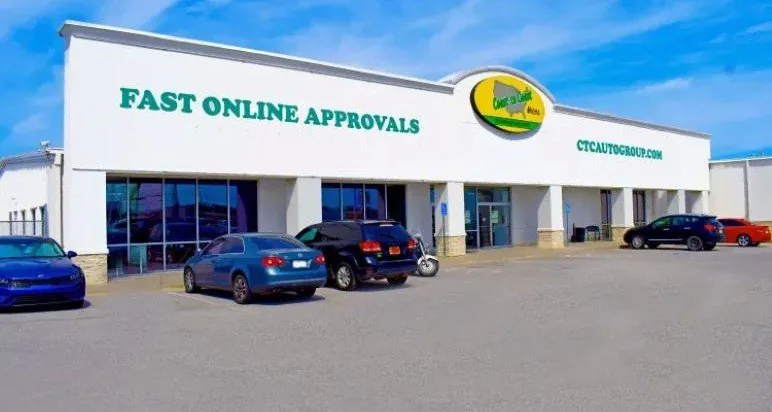
The Tulsa store sits at 4430 S Memorial Dr and runs on the same playbook as the OKC lots: in-house approval on income, ITIN accepted in place of an SSN, and the credit-rebuilding piece that makes the second chance worth taking. Coast to Coast reports your payment history to TransUnion every month, so a Tulsa buyer turned away elsewhere can drive a reliable used car and, with each on-time payment, steadily rebuild the credit that triggered the denial in the first place. You can browse the Oklahoma inventory to see what's available before you stop in.
Buyer profile: which path fits your credit?
The route that makes sense for you comes down mostly to where your credit sits today. The table below pairs the usual best fit with each kind of buyer — find the row that sounds like you and start there.
| Buyer profile | Typical credit range | Best-fit financing | Why |
|---|---|---|---|
| Good credit | 670+ | Traditional bank / credit-union loan | Qualifies for the lowest rates; in-house rarely makes sense |
| Fair credit | 620–669 | Bank loan first, in-house as backup | May qualify at a bank, but in-house is faster if denied |
| Bad credit | 500–619 | In-house financing | Banks often deny; in-house approves on income and down payment |
| Very bad / deep subprime | Below 500 | In-house financing | Bank approval is rare; in-house evaluates ability to pay now |
| No credit | No score / thin file | In-house financing | No history to underwrite at a bank; in-house evaluates current income |
| ITIN buyers (no SSN) | Varies | In-house (where ITIN is accepted) | Most banks require an SSN; Coast to Coast accepts an ITIN |
A quick rule of thumb: if your credit is only fair, price a traditional loan first, since the rate is usually lower. Bad-credit, no-credit, and ITIN buyers are squarely the fit for in-house financing — and within that group, choosing a dealer that reports to a bureau is what makes the loan a step forward instead of a dead end.
Why does that reporting detail carry so much weight? Payment history is the single largest factor in your credit score — roughly 35%, per FICO. At a dealer that reports, a 12–24 month run of steady on-time payments can lift a thin or damaged file in a meaningful way. The financing program at Coast to Coast is built around that monthly TransUnion reporting, which is exactly why a bad-credit purchase here doubles as a credit-rebuilding plan. Independent dealers — the segment represented by the National Independent Automobile Dealers Association (NIADA) — built this model specifically to serve the buyers banks turn away.
Key Takeaways
- Bad credit means a FICO score below about 580, with 580–619 treated as subprime; Oklahoma banks tighten or deny in this range.
- A 500 credit score can still buy a car in Oklahoma through a dealer that finances in-house and approves on income, not just your score.
- No credit is also approvable — in-house financing weighs your ability to pay today, and an ITIN works in place of an SSN at dealers like Coast to Coast.
- Subprime buyers make up over 22% of used-vehicle financing (Experian, Q4 2025), so you're far from alone.
- Expect a down payment, commonly starting around $500 — treat any "$0 down" subprime offer as a red flag.
- Budget for Oklahoma costs: a 3.25% excise tax plus the 1.25% vehicle sales tax (about 4.5% combined), the $11 title fee, and an age-based tag fee are due at the sale.
- Ask whether the dealer reports payments. Coast to Coast reports monthly to TransUnion, turning the loan into a credit-rebuilding tool.
- Compare total cost, not just the monthly payment, and never finance more than your budget can handle.
Ready to see what you qualify for?
A quick online pre-approval lays out your likely terms in minutes, with no obligation and no string of bank denials weighing on your file. Bring your ID, proof of income, and proof of residence to an Oklahoma City or Tulsa store, and you can finish in the same visit.
Frequently Asked Questions
How do I buy a car with bad credit in Oklahoma?
Apply at an Oklahoma dealership that offers in-house financing instead of a bank. These dealers approve you based on your current income, job stability, and down payment rather than your credit score, so bad-credit and no-credit buyers can qualify. Bring a valid ID, proof of income, proof of residence, and a down payment, and you can often finish in a single visit at an Oklahoma City or Tulsa lot.
What credit score do I need to buy a car in Oklahoma?
There is no legal minimum credit score to buy a car in Oklahoma. Banks generally want 620 or higher for standard rates, but in-house financing has no fixed score cutoff — it approves on your ability to pay, so buyers in the 500s and those with no score at all can still be approved.
Can I buy a car with a 500 credit score in Oklahoma?
Yes. A 500 score is deep subprime, where most banks decline, but Oklahoma dealerships that finance in-house approve buyers at this level routinely. The decision rests on your income and down payment, not the score alone.
Can I get a car loan with bad credit in Oklahoma City?
Yes. Bad-credit auto loans exist specifically for this situation. Through in-house financing at an Oklahoma City dealership like Coast to Coast Motors, approval is based on your current income and a reasonable down payment rather than a credit-score cutoff, so past credit problems are not an automatic denial.
Can I buy a car with no credit in Oklahoma?
Yes. No credit is often easier to work with than bad credit. In-house financing evaluates your ability to pay now, so a thin or empty credit file is not an obstacle. An ITIN can be used in place of a Social Security number at dealers that accept it, including Coast to Coast Motors in Oklahoma City and Tulsa.
How much down payment do I need for a bad-credit car loan in Oklahoma?
A down payment is required — it is not a $0-down product, and any "no money down" subprime offer is a red flag. Down payments commonly start around $500 and rise with the vehicle's price and your profile. A larger down payment lowers your monthly payment and usually improves your terms, and a trade-in can count toward it.
How much tax do I pay on a used car in Oklahoma?
Oklahoma charges a 3.25% motor-vehicle excise tax ($20 on the first $1,500 of the price, then 3.25% on the rest) plus a 1.25% vehicle sales tax — about 4.5% combined. On a $12,000 used car that's roughly $510, plus an $11 title fee and an annual tag fee based on the vehicle's age. Budget for these on top of the price and your down payment.
What documents do I need to buy a car with bad credit?
You typically need a valid government ID, proof of income (pay stubs or bank statements), proof of residence (a utility bill or lease), a working phone number, personal references, and your down payment. Having these ready speeds up approval.
Will buying a car with bad credit improve my credit score?
It can, but only if the dealership reports your payments to a credit bureau. Coast to Coast Motors reports payment history to TransUnion every month, so each on-time payment builds positive history. Since payment history is the largest factor in most credit scores, a 12–24 month loan can meaningfully improve a thin or damaged file.
Where can I find bad credit car dealerships in Oklahoma City and Tulsa?
Coast to Coast Motors runs two stores in Oklahoma City — the I-240 location at 801 W I-240 Service Rd and the Shields Boulevard location at 4816 S Shields Blvd — plus a Tulsa store at 4430 S Memorial Dr. All work with almost any credit situation, accept an ITIN, and report payments to TransUnion. You can browse the Oklahoma inventory and get pre-approved online first.
Sources
- Experian — State of the Automotive Finance Market (Q4 2025 subprime share; average used-car loan figures) and What is a good credit score
- Consumer Financial Protection Bureau — Auto loans and getting your credit reports
- FICO — Credit score ranges and What's in your credit score (payment history = 35%)
- Equifax — What is a FICO Score
- TransUnion — Credit score basics
- Bankrate — Average credit score to buy a car, 2025
- Service Oklahoma — New & Used Vehicle Registration (3.25% excise tax + 1.25% vehicle sales tax; title and registration fees)
- NIADA — National Independent Automobile Dealers Association